Joseph Stiglitz Quotes
They say that open markets are the solution to everything and, if left alone, the invisible hand will solve all problems. Sadly, the reason the invisible hand often appears invisible is that, quite often, it is not there.
Joseph Stiglitz, Chairman, President's Council of Economic Advisors, Chief Economist, World Bank, View of the Market Economy
Sourced by: Eigen's Political and Historical Quotations


Brandeis was U. S. Supreme Court Justice Louis D. Brandeis, 1856-1941, who wrote that competition would control prices if only healthy competition could be maintained—the problem was resolved by both increasing competition and much more stringent regulation of corporations.


The “Harvard Boys” referred to some free market economics professors who were advising the Russian government on their transition to a democratic industrial democracy. Free market capitalism was a great failure in that instance. However the free market enthusiasts would argue that Russia did not have a legal system, and organized crime was not controlled, and the Russian people where just not used to a free market.


He had just been appointed Finance Minister in the midst of a severe recession with the Japanese stock market and currency badly depressed.


[The metaphor of the stone tablets revers to Moses coming down the mountain and his interaction with God, carrying the 10 Commandments carved in stone tablets.]


This rigid view left no room for regulation which is what almost every modern industrial democracy has chosen. To some of his extremist followers, any government regulation of business or the economy whatsoever, regardless of how little, means that the nation has embraced socialism. It is in this sense that many extreme right wingers viewed Presidents like Franklin Delano Roosevelt, Harry Truman, John Kennedy, Bill Clinton, and Barack Obama as socialists while they saw themselves as opponents of socialism.
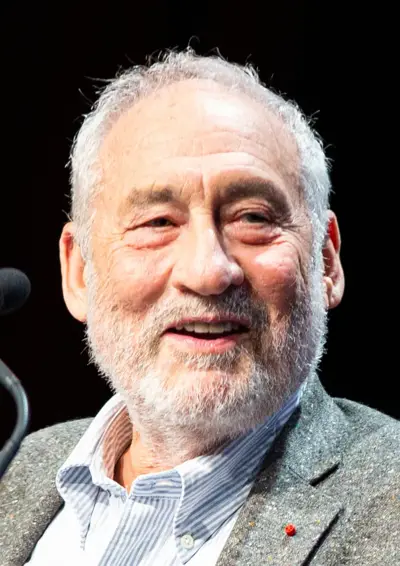
Joseph Eugene Stiglitz is an American economist, public policy analyst, and a professor at Columbia University. He is a recipient of the Nobel Memorial Prize in Economic Sciences (2001) and the John Bates Clark Medal (1979). He is a former senior vice president and chief economist of the World Bank and is a former member and chairman of the (US president's) Council of Economic Advisers. He is known for his support of Georgist public finance theory and for his critical view of the management of globalization, of laissez-faire economists (whom he calls "free-market fundamentalists"), and of international institutions such as the International Monetary Fund and the World Bank.
