Lucian Quotes
These deluded creatures [Christians], you see, have persuaded themselves that they are immortal and will live forever, which explains the contempt of death and willing self-sacrifice so common among them. It was impressed on them too by their lawgiver that from the moment they are converted, deny the gods of Greece, worship the crucified sage, and live after his laws, they are all brothers. They take his instructions completely on faith, with the result that they despise all worldly goods and hold them in common ownership. So any adroit, unscrupulous fellow, who knows the world, has only to get among these simple souls and his fortune is quickly made; he plays with them
This is a particularly interesting contemporary passage about the early Christians. Unlike many who despised the Christians, or thought them dangerous to society, Lucian was an intellectual of his era. He saw the Christians as naïve, ignorant, bumpkins, who could be taken advantage of by unscrupulous people.
Lucian of Samosata, ~120-~190, Greek Satirical Philosopher, The Passing of Peregrinus
Sourced by: Eigen's Political and Historical Quotations

Life listed prominent people who they classified as ‘dupes’ of the communist conspiracy and ‘fellow travelers’, those who associated with ‘communists.’ Ironically, when Einstein was a young man in Berlin, he was one of the few prominent people in Germany who spoke out against the German militarism and the rush to War (WWI). Then he was also referred to as a dupe and a fellow traveler of the English and Americans. Einstein was particularly outspoken against racism and segregation at a time when many Southern, racial conservatives accused all opponents of segregation of being communists or carrying the communist line.

Holy Roman Emperor Frederic II
Compare his report with that of his counterpart of then rival Vietnam: {43139} and the Vietnamese Emperor: {607695}.

Some of the founding fathers were deeply religious men while others were not so. Some varied in their believes at different times of their lives, and a number were not very facorable towards orthodox religion. At the time, Roman Catholic and Protestant churches were persecuting other religions throughout Europe and people were still being killed for their heretical beliefs. Most important to some of them, kings and other monarchs whom they abhorred, all at the time claimed the Divine Right of Kings and the established churches were the most important support for monarchs. At the time most organized religions were opposed to freedom of conscience and certainly opponents of separation of church and state. American churches tended to take on American values but were never given the chance to dominate the American government they way many had in Europe and the rest of the world.


Al-Maarri’s quotations are not only meaningful in their own right, but they illustrate the openness and free thinking that was allowed in the early days of Islam before about 1100. If anyone wrote such things today in most Islamic countries he would at least be jailed if not executed for blasphemy.

In 1900 Argentina was the 4th richest country in the world and had a gross domestic product about the same size as the United States. Misgovernment, ego, delusion, and corruption have impeded their progress since. However, Argentina has had the largest proportion of European ancestry citizens in Latin America. Prejudice being what it was, the European ancestry Latinos perceived themselves better than the descendants of the native Indians or Black slaves. So Argentinians even to this day tend to see themselves as superior to the other Latin nations. And at one point they were amongst the richest countries. Bolivia, in contrast, has the highest proportion of indigenous people and they most of all resent the Argentine attitude of superiority.


Spinoza’s ideas were considered so radical and dangerous that he was the only man in history who was excommunicated by the Catholics, the Jews and the Muslims.


Scientists themselves contain religious believers as well as atheists and agnostics, While there are a number of scientists who argue against religion, there are many who do not and are believers. Albert Einstein, for example, was a believer in a universal God. See {631763}.

When the priest died, 3 handwritten manuscripts were found written and signed by him in which he attacked religion in general and the church and the Bible in particular. His Testament was read by Voltaire and Denis Diderot among others and he was very influential in their development as opponents of organized religion. This quotation has been one of the bases of secular humanism which would then develop after he had died.


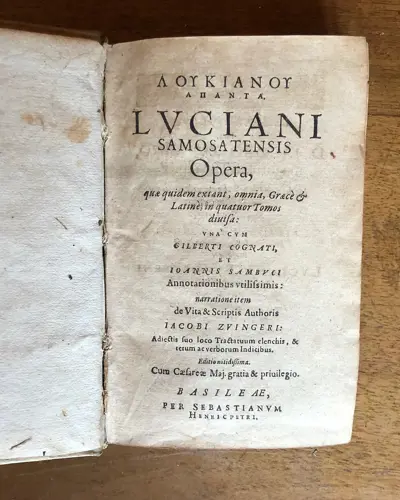
Lucian of Samosata (c. 125 – after 180) was a Syrian satirist and rhetorician who is best known for his characteristic tongue-in-cheek style, with which he frequently ridiculed superstition, religious practices, and belief in the paranormal. Although his native language was probably Syriac, all of his extant works are written entirely in Ancient Greek (mostly in the Attic Greek popular during the Second Sophistic period).
