Life Magazine Quotes
… a dupe and fellow traveler
Life listed prominent people who they classified as ‘dupes’ of the communist conspiracy and ‘fellow travelers’, those who associated with ‘communists.’ Ironically, when Einstein was a young man in Berlin, he was one of the few prominent people in Germany who spoke out against the German militarism and the rush to War (WWI). Then he was also referred to as a dupe and a fellow traveler of the English and Americans. Einstein was particularly outspoken against racism and segregation at a time when many Southern, racial conservatives accused all opponents of segregation of being communists or carrying the communist line.
Life Magazine, Description of Albert Einstein, April 4, 1949
Sourced by: Eigen's Political and Historical Quotations

Accusing her of being a fellow traveler with Communist sympathies, Nixon called her "the Pink Lady" and said she was "pink right down to her underwear." See {627826} and {619498}. Douglas and her campaign thought the accusations were so absurd that at first they did not even bother to respond. Nixon repeated the them and stayed “on message” and by the time that Douglas, who had opposed communism all her life, was believed to be one or at least a “fellow traveler” by most Californians—and finally she responded with statements like this, but it was way too late to turn public perception around. She awarded Nixon the derogatory nickname “Tricky Dick” which the majority of the public used for him throughout his career--{600036}.


After the invasion, much of the intelligence upon which America relied on Invading Iraq turned out to be completely wrong. It turned out that the Vice President at least, a major supporter of the invasion, had a role in “shaping” the intelligence and analysis to achieve a policy objective.

Even the President was not spared during the McCarthy era. The red scare was so pervasive, that a lunatic fringe ultra right wing organization could call the President a “communist dupe” and be taken seriously be much of the media who were themselves intimidated and might be accused of being communists at any moment. It was a very low point in America’s history.


In December of 1940 President Roosevelt delivered a Fireside Chat calling for full aid to Britain. The senator described it as:

Mandela was the head of the African National Congress a revolutionary party fighting against the then dictatorial apartheid government. As the head of the ANC armed wing, after years of peaceful protests and suffering literal massacres of people for nothing other than protesting, Mandela embarked upon a program of sabotage of military and government facilities reserving guerrilla warfare if that failed. Mandela was arrested for the sabotage and served 27 years in jail. While Mandela was incarcerated, the government resorted to death squads and massacres and the ANC retaliated with counter terrorism—but Mandela was not a part of it. There were a number of communists in the ANC movement, but when Mandela, released from jail, became the President of the integrated country, he maintained supported a capitalistic system which it has been ever since. However his refusal to purge the ANC of communists when he needed all the help he could get, has been held against him by some arch conservatives. To many of them, a communist is a communist, a friend of a communist is a communist, a person who knowingly works with or associates with communists is a communist, a revolutionary is a communist, a person who advocates whatever communists advocate is a communist, a person who opposes the investigation of communists in any field of endeavor is a communist. Mandella opposed racial discrimination and the Communist party also did to embarrass the US and other capitalistic countries which then had legal discrimination. Therefore, Mandella was accused of being a communist early in his career. The same thing happened in the United States where anyone who advocated Civil Rights and racial equality was a communist because he/she was echoing the communist line.


Cicely Isabel Fairfield

Amy is responding to Michelle Obama’s claim that “any woman who voted against Hillary Clinton voted against their own voice.”


Alsop, a political hawk was convinced, as many other right wingers were at the time that the Russians had forged ahead of us in offensive missiles. When he asked President Eisenhower, the President never denied it, but never went to Congress to ask for more money to close the “missile gap”. Alsop made this shocking accusation which offended many Americans, but pleased the ultra-hawks and anti-communists. Most of the nation however then believed that there was a missile gap, with varying explanations of Eisenhower’s silence on the matter. Two years later John F. Kennedy, used the “missile gap” when running in 1960 against Nixon by attacking Nixon and Eisenhower for allowing us to fall behind the Russians at have a missile gap. When Kennedy became President, he was very surprised that there was no missile gap favoring the Russians—it was favoring the United States. Eisenhower did not want the Russians to know that he knew exactly what they were producing and deploying in missiles through great espionage sources. By not saying anything in the face of the accusations, the Russians assumed that the Americans really thought that they had more capacity than they did. And Eisenhower wanted that so that they would be secure that the United States had no real knowledge of their missile capacity. If Eisenhower had actually told the nation that the Russians were really behind us, the Russians would suspect a security leak and our sources could be compromised.


Surprising to most people who know of President Theodore Roosevelt’s general liberal views, his 4th son was an ultraconservative who founded and joined racist, anti-Semitic, right wing organizations, and to the distress of many in the family and without lent his name to many of the most extreme right wing causes and organizations.


This is a particularly interesting contemporary passage about the early Christians. Unlike many who despised the Christians, or thought them dangerous to society, Lucian was an intellectual of his era. He saw the Christians as naïve, ignorant, bumpkins, who could be taken advantage of by unscrupulous people.


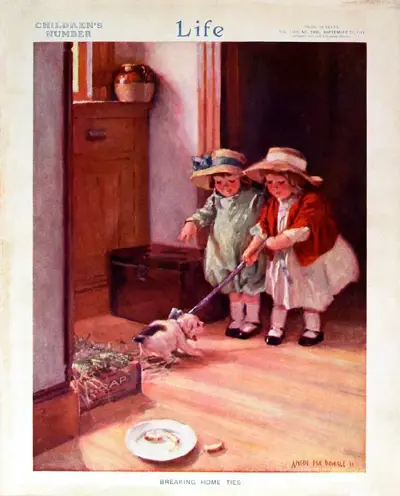
Life was an American magazine published weekly from 1883 to 1972, as an intermittent "special" until 1978, and as a monthly from 1978 until 2000. During its golden age from 1936 to 1972, Life was a wide-ranging weekly general-interest magazine known for the quality of its photography.
