Ann Nocenti Quotes
There was a Japantown in San Francisco, but after the internment camps that locked up all the Japanese, Japantown shrunk down to just a couple tourist blocks.
Nocenti, Ann. Interview by Jeffrey Renaud. "Ann Nocenti Explores the Heart and Soul of 'Katana'." Comic Book Resources, Valnet Inc., 16 Jan. 2013.


Shortly after the Japanese attack on Pearl Harbor:

In one of the great American disgraces, during WWII, American citizens of Japanese ethnicity were forced into an “evacuation” into camps for the duration of the war. German American citizens were not similarly treated. There was not a single act of sabotage or anti war propaganda by Japanese Americans before (or after) the “evacuation.” Many German Americans were so involved but never interned, but one of the major motivations was to get the valuable farmland owned by many Japanese on the West Coast. (The Japanese American citizens could not work or earn the money to pay the mortgages or taxes on their property and the white Californians were able to acquire the land for very little. Many believe this was the real motivation for the Japanese American incarceration as there was none such on the East Coast where there were few Japanese American land holdings.

The Proclamation was a belated admission of the disgraceful internment of loyal Japanese Americans during WWII. See {587961}. “Evacuation” was the euphemism for rounding up Japanese American citizens and putting them in internment camps. Not a single Japanese American was involved in any effort to sabotage or undermine the United States. The same cannot be said about the German Americans where a few did work against U. S. interests and yet the German-Americans were never rounded up. The explanation of the difference has been long debated. Racism was a part of it; California paranoia, another. And unfortunately, Japanese Americans owned very desirable land in California and when they could no longer make their payments some interests gobbled up the land and that was a motivation for some. Regardless, it was one of the low points in American history, and warranted this Presidential and national apology.


This statement shortly after the Japanese attacked Pearl Harbor, was remarkably prescient. The last sentence was exactly what happened although at the time some criticized him for being too paranoid about racial matters.
The initial reaction was to prevent Japanese from leaving the area, being out at night, or spending their assets. Incredibly, Japanese-American citizens who had their own hard earned money in a bank were not allowed to withdraw and spend their own funds. Her family had owned a farm on prime land. Soon, whites looking to get the land owned by Japanese Americans lobbied to have the Japanese removed. They lost their livelihood, would default on their mortgages, and much land fell into the hands of whites. Gruenwald’s family did not lose their farm thanks to the local sheriff who had agreed to supervise the farm and split the profits. Not all West Coast Americans approved of the treatment of their Japanese fellow citizens and many helped protect some from the greed and racism of other Americans. See {624010}.

She was very conflicted about the interment of Americans of Japanese origin. She understood the arguments for the internment and some had some merit for her. But she was opposed to the internment from the beginning. However, she frequently discussed this issue privately with FDR. She consulted with the judges who dissented in the law suits and presented their arguments to her husband. She visited some of the internment camps and maintained a correspondent with some of the interned Japanese American leaders. Earlier, once FDR signed the internment executive order, she maintained a public silence on the issue until 1944 when she publicly broke with her husband on this issue. (While that may be shocking to us today—for a first lady to publicly disagree with the President—for Mrs. Roosevelt, it was not unusual and was not the scandal that it might be today. Throughout her over 3 terms as First Lady, she wrote a daily newspaper column and did a weekly radio show for much of the period.

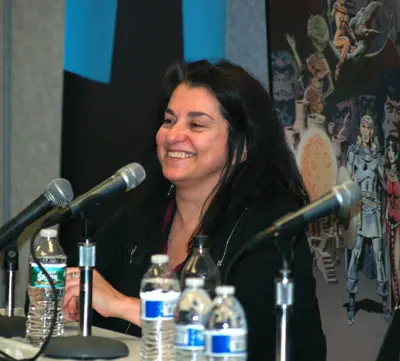
Ann "Annie" Nocenti is an American journalist, writer, teacher, editor, and filmmaker. She is best known for her work in comic books. As an editor for Marvel Comics, she edited New Mutants and The Uncanny X-Men. With artist collaborators, she created such Marvel characters as Typhoid Mary, Blackheart, Longshot, Mojo, and Spiral.
