Joseph McKenna Quotes
There is certainly nothing anomalous in punishing the crime of murder differently in different jurisdictions.
Joseph McKenna, 1843-1926, U. S. Supreme Court Justice, Johnson v. United States, 1911
Sourced by: Eigen's Political and Historical Quotations


Most people reading this think at first that if comes out of the Middle Ages, but it is quite contemporary expressing a point of view that holds that the state is but the instrument of and subservient to God as defined by Protestant Fundamentalism.


Article 17 of the Egyptian criminal code allows judges to reduce or even suspend sentences after a conviction. That has been used to effectively exonerate murders where “honor killing”—the killing of a woman or man whose alleged behavior was contradictory to existing mores, thus bringing dishonor upon the family. Women who were suspected of adultery or even dressing immodestly were murdered by husbands, brothers or fathers without any serious criminal punishment. Some have called for repeal of Article 17.

This proverb only makes sense in the light of understanding the Arab concept of revenge—“blood.” In a rural desert environment where little can be expected of government, the Arabs have developed a law enforcement and peace keeping mechanism which while primitive from modern standards, nevertheless worked to some degree. It is that revenge—“blood” is a moral necessity and obligation of all people, and revenge is not limited by time or to the individuals involved in the first incidence. The immediate family are the first to extract revenge, but the extended family follows and often the entire clan. Sometimes revenge is tribal or even national. Anyone who fails to revenge a member in his group is not only a disgrace, but is a clear and present danger to the group because then they can be attacked with impunity. So revenge is a strong obligation of the group members and blood must be paid with blood no matter how many generations it may take. The only thing that keeps me and my family safe, is the surety what whosoever kills one of us will themselves be killed or if they die a natural death we will take revenge on one of the evildoers relatives. Crime must never pay!

He was the first person to make the distinction in English law between murder and accidental homicide. Earlier they both carried the same death penalty. Bracton, with murder and with theft, wrote of the concept of “mens rea”—criminal mind or intent which is a fundamental principle of modern law. Aristotle, in his Nichomachean Ethics, made similar distinctions of responsibility depending on intent, but Bracton codified it in English law.


A number of the American soldiers refused to obey Calley's illegal order. Some helped some villagers to escape, and a helicopter pilot landed betreen Callery's men and the villagers they were shooting at, and ordered his helicopter machine gun crew to fire on the soldiers if they did back off. The soldiers stopped firing at the civillians. However, his and other reports of the massacre were covered up by the military for a few years. Mai Lai was not the only major war crime perpetrated by Americans in the Vietnam War; there had been a few others. But given the years of fighting and the many opportunities war crimes violations under orders were quite rare. The Viet Cong had many more war crimes that they perpetrated, and our South Vietnamese allies repeatedly committed war crimes against their own people.


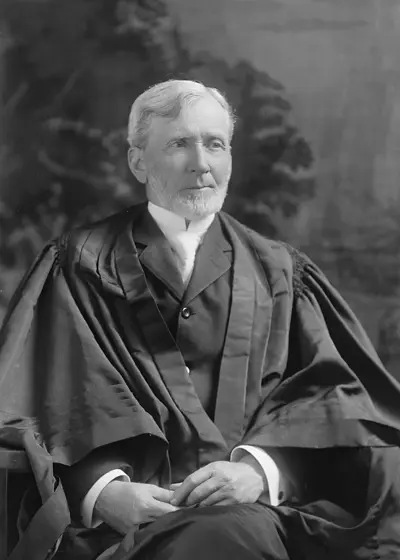
Joseph McKenna was an American politician who served in all three branches of the U.S. federal government, as a member of the U.S. House of Representatives, as U.S. Attorney General and as an Associate Justice of the Supreme Court. He is one of seventeen members of the House of Representatives who subsequently served on the Supreme Court (including two Chief Justices).
