W. E. B. Du Bois Quotes
There is always a certain glamour about the idea of a nation rising up to crush an evil simply because it is wrong. Unfortunately, this can seldom be realized in real life; for the very existence of the evil usually argues a moral weakness in the very place where extraordinary moral strength is called for.
W. E. B. Du Bois, 1868-1963, Educator & Author, Co-Founder of the NAACP, The Suppression of the African Slave Trade to the United States of America, 1897
Sourced by: Eigen's Political and Historical Quotations


See {640733} for an English political leader’s similar view.

Muslim League leaders wanted to stir up India's Muslims in order to prevent Indian Independence from Britain unless India were partitioned and the Muslims could have their own nation. At that point the British and the Congress Party of India—the majority political party were both starting to plan for independence. Most of the Muslim nationalists did not want to have any Muslims living in a Majority Hindu nation. To stop it, they first used fear claiming that when the British left, the Hindus would massacre all the Muslims. They galvanized the Muslims to first attack the Hindus to dissuade then from their attacks which at that point were imaginary except in the conspiracy theory of the Muslim League. The moral logic of this statement was similar, albeit not to the same bloody degree, as the famous quotation of Presidential Candidate Barry Goldwater on extremism." H. S. Suhrawardy

For a similar sentiment, see Thurgood Marshall.


This vague criterion was in effect and was initially used to clear scientists at Los Alamos and their spouses who were part of the team that was to develop the Atomic Bomb. The Army security people however had never been in such a situation before. Few distinguished scientists wanted to come to Los Alamos to begin with as once there, they were there for the duration of the war and were cut off from friends and relatives. But there were very few people in the entire country who had the unique education and training. When the security people rejected a candidate before that time, another person was recruited. But for many of the scientists at Los Alamos, they were one of a kind. There were not two Enrico Femi’s or Luis Alverez’s. “Moral fiber” could mean anything and the American academic world has always tolerated a wider variety of behavior then most of the rest of society. Sexual activity, left wing views, parental irresponsibility, failure to pay debts, attacking religion or religious organizations all created problems. But the biggest problem was association with others of “demonstrated weakness in moral fiber” including communists and left wingers. In most university settings, with a norm or tolerance, almost all associated with “undesirables”. As a result many scientists or family members could not get cleared. But the project could not function without them, and if some were fired for that reason, many others might have quit. Finally, General Groves, relaxed the standards, yet the army security officers were constantly suspicious. This criterion was in use as late as the 1960s where a brilliant scientist working in the Executive Office of the President was threatened with dismissal for this reason. She had borne an illegitimate child years earlier.


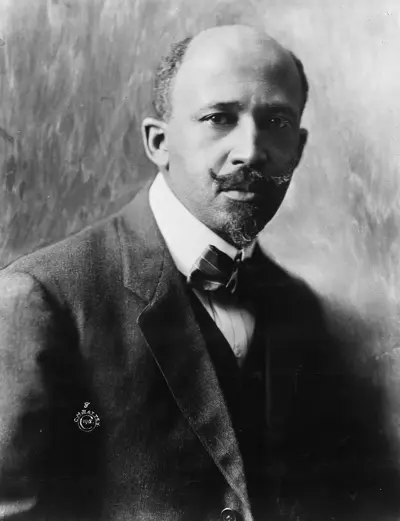
William Edward Burghardt Du Bois was an American sociologist, socialist, historian, and Pan-Africanist civil rights activist. Born in Great Barrington, Massachusetts, Du Bois grew up in a relatively tolerant and integrated community. After completing graduate work at the Friedrich Wilhelm University (in Berlin, Germany) and Harvard University, where he was the first African American to earn a doctorate, he became a professor of history, sociology, and economics at Atlanta University. Du Bois was one of the founders of the National Association for the Advancement of Colored People (NAACP) in 1909.
