Benedict Arnold Quotes
There has long subsisted a Jealousy between Congress and the Army. The former have been Jealous of the Power of the latter, and the latter have thought themselves neglected, and ill treated by the former, who have excluded the Army from every Appointment of honor, or profit in the Civil Line. The Common Soldiers are exceedingly disgusted with the Service, and every effort to recruit the Army (except by Temporary Draughts of Militia) has hitherto proved ineffectual.
Arnold had gone over to the British Side, and was providing intelligence information about the Continental Army. Obtaining troops had been exceedingly difficult for the revolutionaries and the Army leadership, including General Washington, were distressed with the way Congress was handling things.
Benedict Arnold, 1741-1801, Revolutionary War Major General & Traitor, A Report On The Continental Army, Intelligence Report to Lord Germane, October 7, 1780
Sourced by: Eigen's Political and Historical Quotations


The infighting, jealousy and hatred of the Nazi leadership was extreme and not known until later. Hitler was the force that kept them from each others’ throats.

The Attorney General had taken the position that the Congress could not pass laws in time of war that the President was required to follow if in his judgment as Commander in Chief, the war effort and safety of the nation was at stake—that he could instruct the military to ignore laws passed by Congress. The legal theory of the George W. Bush administration was that the President had “inherent powers” under the Constitution and that Congress could not supersede these by legislation.

“Those in power” referred to the Continental Congress and the Governors of the States. Washington, Hamilton, Greene and other senior officers throughout the war pleaded with Congress and the States to provide for the Army. The Governors and state legislatures cared little for a national government as it might reduce their authorities and powers, and the Continental Congress was extremely weak with its leaders very timid. As Greene reported, everyone realized that they might all be ruined but few would act especially if it would cost money. And the Continental Congress had few ways of raising money. It was this obvious failure of the States and the Continental Congress that led to the Constitution.

While we think of the Founding Fathers as great and noble men, it is interesting to consider a contemporary view of the American leadership from another leading American who chose the British side in the conflict. The British and the Loyalists suspected most of the revolutionary leaders as men who were very ambitious for personal gain and economically unsuccessful compared to many others of the then American “establishment.”


Speaker of the House Thomas Reid is:. The nickname stuck, and Reed was known thereafter as "Czar Reed" by friends and enemies alike.


After the King’s appointment in 1921 she “advised” him on establishing this regime and operating the government. At a time that women could not even vote in England, Bell was a kingmaker and major power in an area of the world that was much more sexist than England at the time.


The Continental Congress had treated the army poorly throughout the war with few provisions, erratic pay, and little understanding of the reality of the war effort. He addressed the senior officers of the army urging that the army not disband as Congress had ordered until there was some assurance that they should be reasonably treated and that they would not become public charges. Many had lost everything they owned, not being able to tend their farms or businesses; others were wounded and permanently handicapped. The officers did not follow Armstrong and instead followed the lead of George Washington and returned to civilian life in good faith, but as Armstrong had predicted, Congress did little to compensate the army. Despite his urging disobedience to Congress, once the Constitution was ratified and the government became more stable, Armstrong received several major Presidential appointments and was confirmed by the Senate which he had so castigated.

This was the case where the Supreme Court reversed its earlier opinion and declared the Income Tax Unconstitutional.

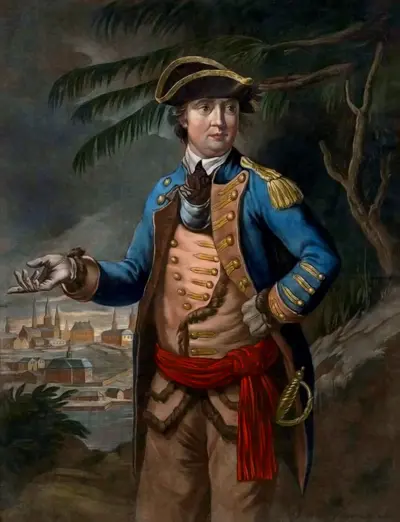
Benedict Arnold was an American military officer who served during the Revolutionary War. He fought with distinction for the American Continental Army, rising to the rank of major general, before defecting to the British side of the conflict in 1780. General George Washington had given him his fullest trust and placed him in command of West Point, New York. Arnold planned to surrender the fort to British forces, but the plot was discovered in September 1780 and he fled to the British lines. Arnold received a commission as a brigadier general in the British Army, commanding the American Legion in the later part of the conflict. Arnold's name quickly became a byword in the United States for treason and betrayal because he led the British army in battle against the very men whom he had once commanded.
