Calvin Coolidge Quotes
There are racial considerations too grave to be brushed aside for any sentimental reasons. Biological laws tell us that certain divergent people will not mix or blend. The Nordics propagate themselves successfully. With other races, the outcome shows deterioration on both sides. Quality of mind and body suggests that observance of ethnic law is as great a necessity to a nation
as immigration law.
Coolidge, Calvin. "Whose Country Is This?" Good Housekeeping, Feb. 1921, p. 13.


Rowan was primarily referring to the miscegenation that took place since Negro slavery in the Americas. Rape of slaves by white “masters” and their male relatives was common. In addition there have been interracial romantic relationships from the time Blacks were first in America. These have increased dramatically in the 20th and 21st centuries. However, he was slightly in error as he did not consider the origin of man, where science has traced the DNA of EVERY human on Earth back to a Black African female. Hence 100 percent of humans have “Negroid” blood in the sense that there has been inter-racial breeding in the past.
He was silent regarding the Indian men who were living with and married to white women. The double standard operated even to issues of blood purity. His view at the time is remarkably consonant with those of right wing fundamentalists at the time and today, the Nazi’s of Germany, and other non Indians.


Bilbo was one of the worst racists who ever served in the Congress.
This book was the first popular attempt to spread the eugenics concept. Is was translated into German in 1925 and unfortunately read by Adolf Hitler who sent Grant a complimentary letter. See {603544} and {602054}

The danger of racial and ethnic interbreeding was a fabricated myth. We now know that the danger can come from pure breeding and not obtaining enough genetic diversity. One reason that man has been so successful is that the species is the product of very extensive genetic diversity. For example EVERY human being on the planet had some genetic relationship to a Black African woman.

Russell like the rest of the Southern Congressional delegation, though members of the President’s own party were vehemently opposed to any civil rights legislation that would erode the legal racism and segregation that was prevalent in the South. The irony of Russell’s statement is that by Russell’s definition of a “mongrel race” the South was just that. And in a very real genetic sense all the great civilizations were characterized by interbreeding which is what Russell and other Southerners were paranoid about. The Southern institution of slavery was rife with the sexual abuse of the female slaves by the white masters and/or members of their family, overseers and other whites with power over the slaves. While many of the offspring were identifiable as mixed race (defined as Black by the laws at the time) many appeared to be white and light skinned enough to “pass” and did. A very large percentage of Southern white and black families had mixed blood in the family when Russell was complaining. More to the point, although it was not known at the time, we now know that every human being on earth can be genetically traced back through myocardial DNA to Blacks emanating from Africa. However, even using his narrow vision of race, his history was wanting. A number of great civilizations were of mixed race. One dramatic example was the great dynasties of Egypt. Cleopatra, herself, was from the union of Alexander the Great’s Greek General Ptolemy and the traditional line of Egyptian Pharos. Alexander’s Greek Soldiers interbred, as part of Alexander’s policy of occupation as suggested by Aristotle. All those societies thereafter were “mongrel” races at least in the ruling and upper classes. Actually the United States and the Soviet Union, the two super powers of the day both were ethnically and racially, highly diversified and both had a great deal of miscegenation. Scientists had made a very good argument that miscegenation strengthens a people—not weakens it.


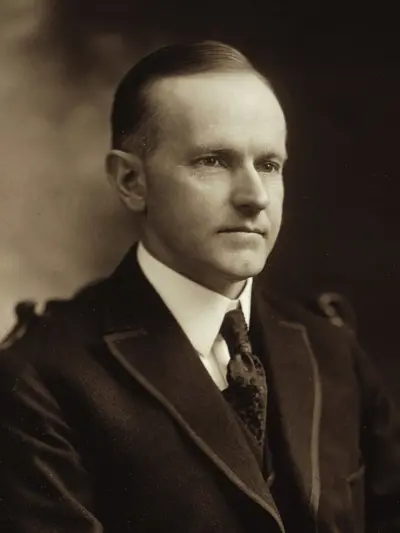
Calvin Coolidge was an American lawyer and politician who served as the 30th president of the United States from 1923 to 1929. A Republican lawyer from New England, born in Vermont, Coolidge worked his way up the ladder of Massachusetts state politics, eventually becoming governor of Massachusetts. His response to the Boston Police Strike of 1919 thrust him into the national spotlight and gave him a reputation as a man of decisive action. The next year, he was elected the 29th vice president of the United States, and he succeeded to the presidency upon the sudden death of Warren G. Harding in 1923. Elected in his own right in 1924, he gained a reputation as a small-government conservative and also as a man who said very little and had a rather dry sense of humor.
