George B. McClellan Quotes
The West will never understand Muslims so long as we ... judge them by the rules we are accustomed to apply to ourselves.
Although he was a failure as a fighting general, he was prescient in this advice which would have helped had it been heeded by American policy makers at the beginning of the 21st Century.
George B. McClellan, 1826-1885, General-in-Chief of the Union Army, Democratic candidate for President, Writing after he visited the Middle East, 1874
Sourced by: Eigen's Political and Historical Quotations

Many Arab orthodox Muslims would be terribly angry and insulted if Islam or key elements of it were insulted. To them this was obscene. Culturally, sarcastic comedic attacks and insults in general are not common in Arab culture. Making fun of Islam or the Prophet was unheard of. Under Sharia (Islamic Law) this is heresy and must be stopped, with the heretic put to death. In the early 21st century, the Internet and other modern communications exposed Muslims to the West in a level of detail that had been unknown before. Satirical TV shows like South Park and political and social cartooning in Western countries sometimes made fun of Islam and Muhammad, and militant Muslims would exploit these situations to produce huge protests including violent attacks on Westerners or interests of the countries where these “offences” took place. With little or no understanding of freedom of speech, many Arabs saw governments that would “allow” such satire as attacking and wanting to destroy Islam.


Half the population of Amsterdam was at the time non Western in origin including many Muslims. Cohen was one of the few major Dutch leaders who worked to make multiculturalism work. However, there were so many religious Muslim extremists already active in the Netherlands, that it was very difficult. The Dutch had elected a Muslim as a member of Parliament and whole many Muslims were very proud of this, the religious extremists were furious. She was a woman, and she did not believe or advocate that Holland adopt Sharia (Islamic) law. She was an Islamic reformer who was opposed to Sharia even in Muslim states. The most successful Islamic nation, Turkey, does not allow Sharia law, and Indonesia, the largest of the Muslim nations also does not follow it.


One of the great historical religious puzzles is how Islam evolved from its origin of respect for other religions, to one where a large number of Islamic leaders preach that not only is Islam the only true religion but all other religions are enemies of Islam, and the preaching of hatred for Christians, Jews, Bhai, Budhists and other religions.


Islam is a religion, like many Christian sects, where conversion of non-believers is a religious duty. When many of the European day-to-day customs, conflict with Islamic custom or prescription, decadence and the desire to change it becomes a very predictable result.
Muslims participating in political demonstrations Theological & Legal Expert. A fatwa is a religious legal ruling
Turkey under its great leader, Ataturk, underwent a major cultural revolution. Although Turkey is overwhelmingly Muslim, its constitution provides that it be a secular state with compulsory public non-sectarian education. They adopted a European style law and prohibited Sharia (Islamic law). The nation thrived as no other Muslim country has. Muslims, the world over, are divided on Turkey. For this Sheikh its secular government is an insult to Islam because there is complete separation of mosque and state. For others it is the model which all Muslim countries should emulate.
al-Mansur Abu Ali. Even though the Caliph was trying to return to Muslim Fundamentalism, there was a general tolerance that was far in advance of Christian societies at the time. It is dramatically at variance with many of the more rigorous Islamic countries today.
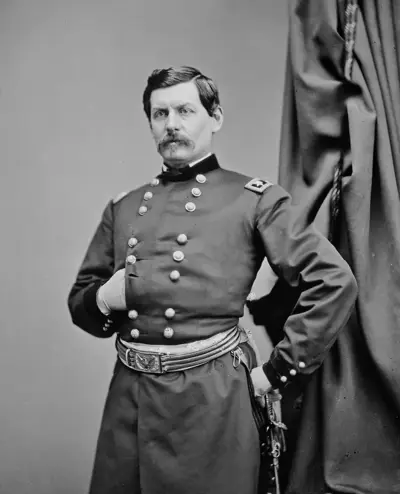
George Brinton McClellan was an American soldier, civil engineer, railroad executive, and politician who served as the 24th Governor of New Jersey. A graduate of West Point, McClellan served with distinction during the Mexican–American War (1846–1848), and later left the Army to work on railroads until the outbreak of the American Civil War (1861–1865). Early in the conflict, McClellan was appointed to the rank of major general and played an important role in raising a well-trained and organized army, which would become the Army of the Potomac in the Eastern Theater; he served a brief period (November 1861 to March 1862) as Commanding General of the United States Army of the Union Army.
