Mary Ritter Beard Quotes
The trade agreement has become a rather distinct feature of the American labor movement. ... It is based on the idea that labor shall accept the capitalist system of production and make terms of peace with it.
Beard, Mary Ritter. A Short History of the American Labor Movement. Harcourt, Brace and Howe, 1920, p. 170.


This was praise indeed as Wellman was generally very conservative.


Roosevelt shocked the conservative members of his own party with this statement. Labor unions were not then an accepted concept in American society. Anti trust legislation and enforcement was in its infancy and companies in an industry commonly conspired as to price fixing, labor negotiations and market share allocations. TR had a scrupulous sense of fairness and equity.


The act gave unions rights of organization which they had not had before in America, but few critics ever characterized it in the over the top rhetoric which was characteristic of Nixon in his early political years.

At the time, the mine owners and operators claimed that they had NO obligations to their workers—not even to ensure a safe mine. There was no OSHA and workers died and were maimed on the job much more frequently than they do today. Many mine owners now accept that they have obligations to the workers, and the rest are required to have responsible and safe working conditions by law and OSHA regulations.

At the time, it did seem impossible that labor and capital would ever have harmonious relations. But the notion that slavery would solve the problem is as preposterous as anything ever entered into the American political dialogue. But there were many in the South, and some in the North, who actually believed it. Even 150 years later, while labor and capital relations were much better than pre Civil War, they still could not be described as “harmonious” or “friendly”.

Hydrophobia was a name for rabies where and infected rabid animal would seemingly irrationally attack almost anything in the immediate vicinity. Gompers was the elected head of the newly formed American Federation of Labor which like all other active unions and union organizations to terrorize Van Cleave and other members of the NAM. Van Cleave was rabidly opposed to any anti-trust government “interference” with business and he was also virulently opposed to labor unions. See {638616}, {638615}, {638612}, and {638613}.


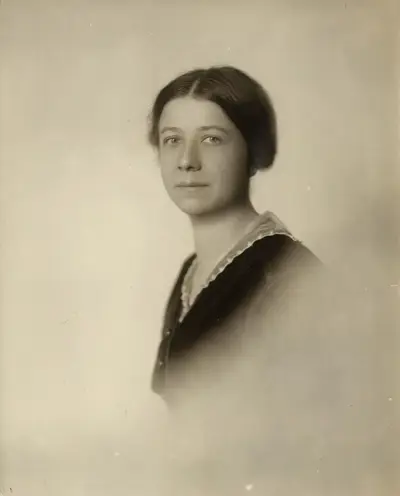
Mary Ritter Beard was an American historian, author, women's suffrage activist, and women's history archivist who was also a lifelong advocate of social justice. As a Progressive Era reformer, Beard was active in both the labor and women's rights movements. She also authored several books on women's role in history including On Understanding Women (1931), America Through Women's Eyes (editor, 1933), and Woman as Force in History: A Study in Traditions and Realities (1946), her major work. In addition, she collaborated with her husband, historian Charles Austin Beard, as coauthor of seven textbooks, most notably The Rise of American Civilization (1927), two volumes, and America in Midpassage: A Study of the Idea of Civilization (1939) and The American Spirit (1942), the third and fourth volume of The Rise of American Civilization series. A standalone book, Basic History of the United States, was their best-selling work.
