Jefferson Davis Quotes
The time for compromise has now passed, and the South is determined to maintain her position, and make all who oppose her smell Southern powder and feel Southern steel.
Davis, Jefferson. The Papers of Jefferson Davis, Volume 7: 1861. Edited by Lynda Lasswell Crist, Louisiana State University Press, 1992, p. 44.

Shortly after, he backed off the notion of having a bloodbath removing protesting students.


The Russians did come shortly thereafter in 2000. They captured Salman Raduyev, who regretted his challenge.


The Falkland Islands were very close to Argentina and far from England. The Argentineans had offered the few Islanders large sums of money to become part of Argentina, but this was rejected. Argentina was a military dictatorship with a terrible record of human rights abuses. The Falklanders preferred their traditional British style of government and affiliation. The Argentinean generals assumed that if they invaded, once they controlled the Falkland Islands, they could negotiate with the British over issues of sovereignty. They misinterpreted the American UN Delegate and concluded that America would not support Britain in a military response; they also assumed that while the British would complain in the UN, they would never go halfway around the world to invade the islands, now occupied and reinforced by Argentina. Thatcher would not negotiate unless the invaders left the islands. They did not do so voluntarily. The Argentinian military had been abusing their own citizens for so long that they had an inflated concept of their fighting ability. Britain freed the islands militarily, and Argentina was humiliated. The military government fell bringing democracy to Argentina—the only good that came out of the Faulklands War.

There was deep hostility and suspicion between Germany and England for several years before WWI. See {642066}.


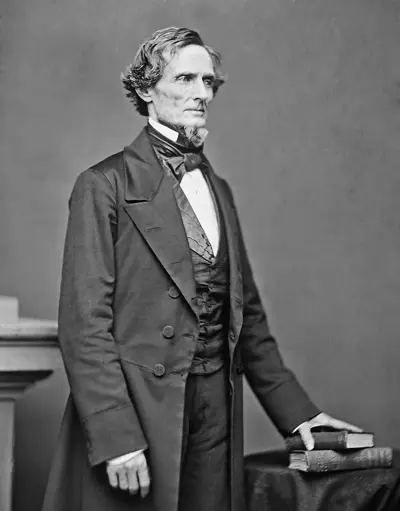
Jefferson Finis Davis was an American politician who served as the president of the Confederate States from 1861 to 1865. As a member of the Democratic Party, he represented Mississippi in the United States Senate and the House of Representatives before the American Civil War. He previously served as the United States Secretary of War from 1853 to 1857 under President Franklin Pierce.
