Felix Frankfurter Quotes
The [Supreme] Court's authority—possessed neither of the purse nor the sword—ultimately rests on sustained public confidence in its moral sanction. Such feeling must be nourished by the Court's complete detachment, in fact and appearance, from political entanglements and by abstention from injecting itself into the clash of political forces and political settlements.
Felix Frankfurter, 1882-1965, U. S. Supreme Court Justice, Quoted in Katcher, Earl Warren: A Political Biography, McGraw Hill, 1967
Sourced by: Eigen's Political and Historical Quotations

At the time of the interview she had retired from the bench.

Then Clarence Thomas replaced Thurgood Marshall on the Supreme Court, there appeared to be a majority of the court that would overturn Roe v. Wade and a woman’s right to an abortion. However it was an election year and the Chief Justice, a Republican, was concerned that if Roe was overturned the electorate might take it out on the Republicans, whose Solicitor Generals had fought to overturn Roe, at the polls. He therefore postponed the hearing of a Pennsylvania case, and then tried to postpone it again till after the election. Blackmun’s memo caused a majority of the court to vote to hear the case with no additional delay. Ironically, by a single vote, Roe was upheld.


He served on a Supreme Court that was as close to political as any had ever been. Hence his great concern.

One of the conundrums of our constitutional system is who has the last word as to what the Constitution means. Essentially it is the judicial branch headed by the Supreme Court. But there are those who believe that the current popular majority should have a say in what is or is not constitutional. If so the legislative branch should have the last word. Still others say that the President is the only person elected by ALL the people, so his opinion most reflects the will of the public. And then there are most who argue that the Constitutional system was created just to avoid the power of currently popular majorities, and the courts should decide based on the Constitution itself. So the statement has very little meaning except that Phillips thinks that the courts have too much power. Whoever gets to decide what is or is not Constitutional will be accused of being “over” the Constitution by those who don’t like the decisions. In our system, that is the courts.

In many nations, there is little judicial independence from the government. Judicial decisions that thwart government sometimes produce retaliation ranging from reducing the pay or staff of judges, threatened investigations and impeachment even arrest and execution---sometimes by government ‘death squads’. Even in the United States, the beginning of the 21st century, was fraught with so many examples of judicial intimidation threats, that two Supreme Court justices began speaking throughout the country to educate the public to this problem. In general, the more democratic and free a nation is, the more frequently the courts will disallow activities of the executive and even the legislature.

The Senate was investigating a scandal where the George W. Bush White House had induced the Attorney General, Alberto Gonzalez, to fire 8 of their own political U. S. Attorney appointments because they had or were investigating/prosecuting Republican politicians for corruption or not prosecuting Democrats vigorously enough. Gonzalez took the responsibility for the firings but did “not remember” why each had been fired nor was there any record in the Justice Department indicating any shortcoming with their jobs. The White House political operatives refused to testify under oath citing “Executive Privilege.”


Hughes constantly allowed that it was improper for a sitting Supreme Court justice to be a candidate for the Presidency. But the Republican Party was badly split between the progressives and the conservatives. Each likely candidate had been on one side or the other, and was therefore unacceptable to the wing he had not supported. Hughes was one of the few Republicans who did not take sides in the 1912 schism as he was a member of the Supreme Court. His neutrality and his absence of any political statements in recent years made him a very attractive Presidential Nominee for Republicans. But his luster would wear off quickly if he let the Republicans know how he stood on any of the issues splitting the party. The only way that he could avoid saying anything was to maintain that he was not and should not be a candidate. Therefore he was nominated. However, to avoid losing one of the wings of his party, he had to essentially take a position on very few issues in the 1916 campaign. He just criticized President Woodrow Wilson and the Democrats. See {642634} for how the Wilson forces turned his avoidance of issues to their advantage.


Commenting on why he no longer attends the State of the Union - six weeks after the Obama-Alito kerfuffle. See linked quote.


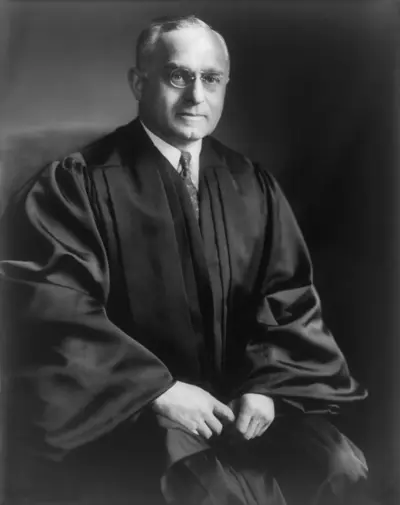
Felix Frankfurter was an American lawyer, professor, and jurist who served as an Associate Justice of the Supreme Court of the United States. Frankfurter served on the Supreme Court from 1939 to 1962 and was a noted advocate of judicial restraint in the judgments of the Court.
