Neil Gorsuch Quotes
I'm distressed to hear you think that judges or the Supreme Court is an organ of a party. That, to me, is just - I know you feel that way. And that distresses me.
Gorsuch, Neil M. Confirmation Hearing on the Nomination of Hon. Neil M. Gorsuch to be an Associate Justice of the Supreme Court of the United States. U.S. Government Publishing Office, 2017.


In many nations, there is little judicial independence from the government. Judicial decisions that thwart government sometimes produce retaliation ranging from reducing the pay or staff of judges, threatened investigations and impeachment even arrest and execution---sometimes by government ‘death squads’. Even in the United States, the beginning of the 21st century, was fraught with so many examples of judicial intimidation threats, that two Supreme Court justices began speaking throughout the country to educate the public to this problem. In general, the more democratic and free a nation is, the more frequently the courts will disallow activities of the executive and even the legislature.

He served on a Supreme Court that was as close to political as any had ever been. Hence his great concern.


See Abraham Lincoln for a similar view.
From time to time, the assessment of a prospective Supreme Court justice has depended on an attempt to move the court in a particular direction or to prevent that. This is as opposed to the issue of the competence of the nominee. In most cases, such nominees may not have been the best qualified but they have been extremely competent. In a few cases, such as that of Justice Clarence Thomas, the justice was mediocre and inexperienced at best, but his virtues were his race and his total ideological consistency. Most attorneys can predict his vote in advance. He has never asked a question in oral arguments. See {623452} .

Judges are restrained by the law and precedence (stare decisis), as well as having to uphold what he/she thinks are undesirable laws or find against laws he thinks are good. He must decide on the law and the facts of the particular case. And if he is an appellate or a Supreme Court judge he must make compromises to accommodate other justices hearing the case along with him/her.

The strongman president, barred from a 3rd 5 year term by the Burundi Constitution, came up with an absurd argument as to why the limit should not apply to him. When the Supreme Court would not go along with the scheme, he threatened them and finally they all reversed their previous opinion and voted to allow it—all except for Nimpagaritse who did not sign the reversal, but was no longer safe. Although the President tried to arrest him, he escaped over the border and went inti exile.

Hughes constantly allowed that it was improper for a sitting Supreme Court justice to be a candidate for the Presidency. But the Republican Party was badly split between the progressives and the conservatives. Each likely candidate had been on one side or the other, and was therefore unacceptable to the wing he had not supported. Hughes was one of the few Republicans who did not take sides in the 1912 schism as he was a member of the Supreme Court. His neutrality and his absence of any political statements in recent years made him a very attractive Presidential Nominee for Republicans. But his luster would wear off quickly if he let the Republicans know how he stood on any of the issues splitting the party. The only way that he could avoid saying anything was to maintain that he was not and should not be a candidate. Therefore he was nominated. However, to avoid losing one of the wings of his party, he had to essentially take a position on very few issues in the 1916 campaign. He just criticized President Woodrow Wilson and the Democrats. See {642634} for how the Wilson forces turned his avoidance of issues to their advantage.


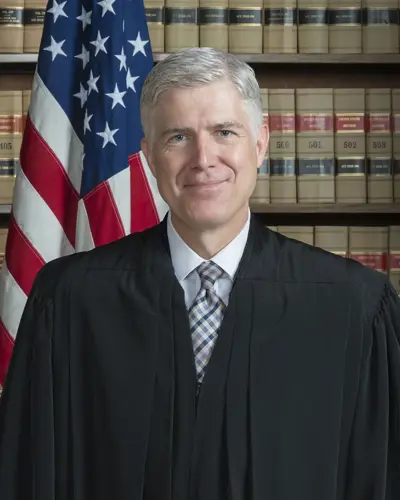
Neil McGill Gorsuch is an associate justice of the Supreme Court of the United States. He was nominated by President Donald Trump on January 31, 2017 and has served since April 10, 2017.
