Ruth Bader Ginsburg Quotes
I don't think that a Justice should have uppermost in her mind, 'A Democratic president appointed me, so I must leave to be sure that another Democratic president can appoint my successor.'
Liptak, Adam. "Justice Ginsburg's Joyful Discourse." The New York Times, 24 Aug. 2013.


From time to time, the assessment of a prospective Supreme Court justice has depended on an attempt to move the court in a particular direction or to prevent that. This is as opposed to the issue of the competence of the nominee. In most cases, such nominees may not have been the best qualified but they have been extremely competent. In a few cases, such as that of Justice Clarence Thomas, the justice was mediocre and inexperienced at best, but his virtues were his race and his total ideological consistency. Most attorneys can predict his vote in advance. He has never asked a question in oral arguments. See {623452} .

The judiciary in the American system must give deference to the executive and legislative branches and interfere only when there is a violation of the Constitution. Many of the laws may well be viewed as bad policy by the judge, or in some case, may be unjust. The judge however cannot interfere just because he is dealing with bad or unjust laws. So Judge Scalia points out that the judge functioning properly in the American system will find that he personally does not like the consequences of his own opinions.


See Abraham Lincoln for a similar view.


This document was a type of Magna Carta but far earlier.
Scalia had been a close friend of the Vice President. He had recently been taken on the Vice President’s plane and they went duck hunting.

Over 30 states at the time required state judges to stand for election. The result was that they had to have money to finance their campaigns like any other politicians. The results were many cases of lack of impartiality and enormous public perception that the judges were beholden to large campaign contributors. Justice O’Connor pointed out to them that they had created their own problems by popularly electing judges.


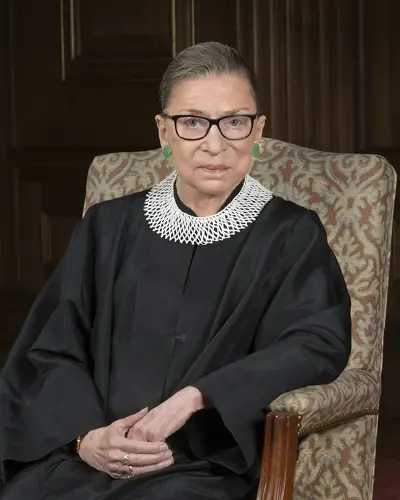
Joan Ruth Bader Ginsburg was an American lawyer and jurist who served as an associate justice of the Supreme Court of the United States from 1993 until her death in September 2020. She was nominated by President Bill Clinton, replacing retiring justice Byron White, and at the time was generally viewed as a moderate consensus-builder. She eventually became part of the liberal wing of the Court as the Court shifted to the right over time. Ginsburg was the first Jewish woman and the second woman to serve on the Court, after Sandra Day O'Connor. During her tenure, Ginsburg wrote notable majority opinions, including United States v. Virginia (1996), Olmstead v. L.C. (1999), Friends of the Earth, Inc. v. Laidlaw Environmental Services, Inc. (2000), and City of Sherrill v. Oneida Indian Nation of New York (2005).
