Adam Smith Quotes
The subjects of every state ought to contribute towards the support of the government, as nearly as possible, in proportion to their respective abilities, that is, in proportion to the revenue which they respectively enjoy under the protection of the state.
Adam Smith, 1723-1790, Scottish Political Economist, The Wealth of Nations, 1776
Sourced by: Eigen's Political and Historical Quotations


The phrase is carved above the entrance to the IRS Headquarters in Washington DC

There are some in America who believe that progressive taxation where the rich pay at a higher rate was an invention of the New Deal and FDR. As this quotation shows, it was a well understood and debated concept before there was a United States.

A tax system should be instituted


At the time, he, th richest man in America was paying a lower ta rate than his secretary, his employees and the waiter who served him lunch. The “Buffet Rule” was developed and named for him that said that wealthy people should pay a minimum rate of taxation regardless of tax credits, deductions and other means of tax avoidance.


This became known as the Buffet Principle—that the very rich should not pay a lower tax rate than the workers who make far less money than they do. President Barack Obama used this principle by name in calling for the 2011 Jobs Act which would eliminate some of the loopholes and exemptions by which the rich could avoid some or much or their tax obligation.


Contrast this statment with Charles Wilson's regarding General Motors and the country.

At the beginning of the First World War the senator called for surplus profits taxes on business to finance the war effort. President Wilson preferred bond financing and the business community castigated the Senator for not supporting the President's position. Later, when Wilson adopted the senator's view and called for additional taxes:

As a result of years of lobbying many vested interests were getting tax exemptions for their activities. Some of the richest corporations and people paid little or no taxes. This was like the old European monarchies where the dukes and nobles got tax exemptions from the king and the middle class and poor people paid a much larger percentage of their income and wealth than did the nobility. Fairness in taxation is very difficult in practice. See {633629}


This was a typical argument in the 2012 battle between President Obama and the Republican conservatives. However, this was written 35 years earlier, when the exact same issue was polarizing politicians. The idea for taxing the rich more to reduce the deficit has been around since there was a Federal deficit. On most occasions the rich had enough political clout to avoid additional taxes for them and get the general public to pay instead of them. However, there have been times where they have not been able to avoid increased taxes. The New Deal lead by Franklin Delano Roosevelt and the Obama administration in 2013 were two such exceptions.

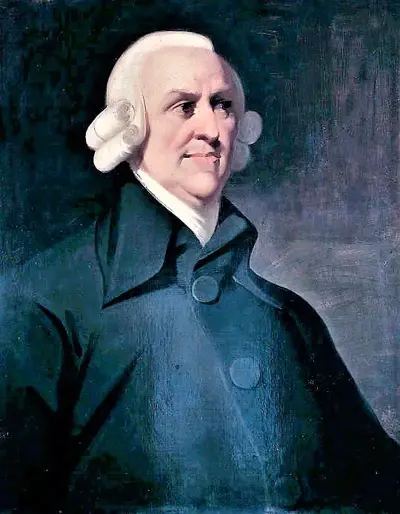
Adam Smith FRSA was a Scottish economist, philosopher as well as a moral philosopher, a pioneer of political economy, and a key figure during the Scottish Enlightenment, also known as ''The Father of Economics'' or ''The Father of Capitalism''. Smith wrote two classic works, The Theory of Moral Sentiments (1759) and An Inquiry into the Nature and Causes of the Wealth of Nations (1776). The latter, often abbreviated as The Wealth of Nations, is considered his magnum opus and the first modern work of economics. In his work, Adam Smith introduced his theory of absolute advantage.
