Daniel Defoe Quotes
The spinning work is performed by the poor people who live in villages and scattered houses. The clothiers, who generally live in the towns, send out the wool weekly to the spinners. At the same time, the clothiers' servants and horses bring back the yarn that they the spinners have spun and finished.
Daniel Defoe, ~1659-1731, British Journalist & Writer, Description of the economics of the clothing business in England, A Tour Through the Whole Island of Great Britain, 1724
Sourced by: Eigen's Political and Historical Quotations


There were few if any consumer protection laws in those days and many wealthy aristocrats made their money by taking advantage of the poor. They were the landowners, bankers, financiers and often the industrialists. Shaw was a sarcastic social critic and this is a typical line he gave his upper class characters. Today, we have more controls on business and finance, and many wealthy business people have gotten that way by providing great value to the consumers and being honest. However, we still have large numbers of wealthy members of society who do make their money from the poor and middle class by unethical and often illegal means. In the aftermath of the Meltdown of 2008. hundreds of thousands of the homes of the working poor and middle class were foreclosed by the major banks forging the legal documentation for the foreclusures. Millions of consumer contracts are issued that even a PhD cannot understand the terms of without special legal and financial training. There is even a legal definition of a salesperson lying to make a sale which is so commonplace that our law excuses it and calls it "puffing". However, there has been over time, improvement over Shaw's era.


The nobles of the city were in rebellion and fought the English Prince of Wales. When the city was taken, the poor people as well as the nobles were executed for their part in the “rebellion.” However, the poor had no say in the matter, and it was not they who ordered the city gates shut and decided to undergo a siege, which in this case was not successful. Limoges was a heavily walled city, well provisioned for a siege, but the English had miners who undermined part of the city walls and crashed them into the moat and allowed the English to walk in easily.
The distinction between recreational drinking and heavy drinking is a subtle one and rarely made until modern times. Most leaders who would not have heavy drinkers in positions of responsibility were usually themselves teetotalers and they were very rare. Heavy drinkers and alcoholics have been in positions of responsibility throughout history including modern times—eg House Ways & Means Chairman Wilbur Mills and Russian President Boris Yeltsin. Peter was unusual in that he made the distinction.

Ransome had a unique access to Post Russian Revolutionary leadership as his fiancée was the secretary to key Russian Communist party committees and through her he had access to Lenin, Trotsky and other leaders. In general Ramsome is best known as a children’s book author.

In 1701 exports of wool accounted for ¼ of all exports. By 1770, it was almost 1/3.

This was an expression of concern from the merchants of Rhode Island to England regarding curtailing aspects of the slave trade. Ironically, this Remonstrance is one of the first documents objecting to the management of America’s affairs by England when America had no representation. Therefore it played a part in the process which culminated in the American Revolution and freedom from England. And yet the subject was not freedom at all but just the opposite—the prerogative of maintaining the slave trade. Note that the appeal to the Board of Trade was not couched in ethical or political argument but as a mercantile argument—Rhode Islander’s would import less British goods.


He was describing England before the Industrial Revolution. The manufacturer / artisan owned his own home and had a small garden. He was not paid very well, but if business was slow his family could subsist by growing his own food and animals. With the Industrial Revolution came specialization as well as mechanization. If business was bad hundreds or thousands of workers had no way to make a living.


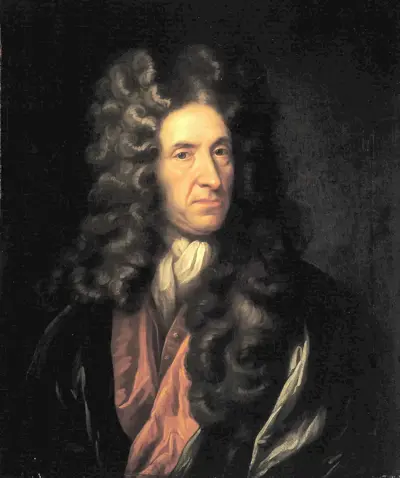
Daniel Defoe was an English trader, writer, journalist, pamphleteer and spy. He is most famous for his novel Robinson Crusoe, published in 1719, which is claimed to be second only to the Bible in its number of translations. He has been seen as one of the earliest proponents of the English novel, and helped to popularise the form in Britain with others such as Aphra Behn and Samuel Richardson. Defoe wrote many political tracts and was often in trouble with the authorities, and spent a period in prison. Intellectuals and political leaders paid attention to his fresh ideas and sometimes consulted with him.
