Roman Empire Quotes
The same case not to be tried twice. There shall be no second action under this law against a person who is condemned or is acquitted in accordance with this law.
Roman Empire, Roman Law regarding Double Jeopardy
Sourced by: Eigen's Political and Historical Quotations

This is one of the earliest prohibitions on ‘double jeopardy’.


Major Fleener had been assigned to defend accused terrorists who were being held at the military prison in Guantanamo, Cuba. For several years they were held without a hearing or trial. Then the U. S. Supreme Court ruled that they had to be given a hearing or trial. A Military tribunal was selected. The methods and procedures of these hearings came under much public world-wide criticism as they did not meet the normal legal standards of most countries. Surprisingly, one of the military officers made public statements criticizing the army and the trials.

On the Fugitive Slave Act: As one of the leading American Catholic intellectuals during the 19th Century, Brownson’s opinions went far in keeping Catholics from joining the side of the abolitionists. However, just a few years later his tone would change and he would become one of the few Catholic writers to refuse to defend slavery, see {610710}. While the majority of Catholics refused to join the abolition movement, they often did so because abolitionism was closely tied to anti-Catholicism, see Gordon {611392} or Shaftesbury {611106}. Other reasons included Irish immigrants fearful of competition from Black labor and the fear of liberal individualism and social disorder, which was prevalent in 19th century Catholic thought. For a further explanation on the relationship between American Catholics and slavery, see McGreevy {612036}.


The highest court in New York.


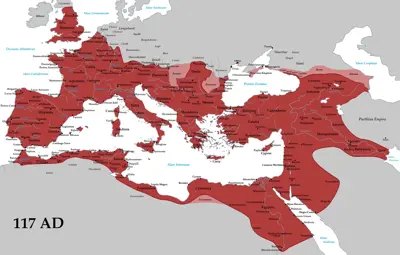
The Roman Empire (Latin: Imperium Romanum [ɪmˈpɛri.ũː roːˈmaːnũː]; Koinē Greek: Βασιλεία τῶν Ῥωμαίων, romanized: Basileía tōn Rhōmaíōn) was the post-Republican period of ancient Rome. As a polity it included large territorial holdings around the Mediterranean Sea in Europe, Northern Africa, and Western Asia ruled by emperors. From the accession of Caesar Augustus to the military anarchy of the 3rd century, it was a principate with Italy as metropole of the provinces and the city of Rome as sole capital (27 BC – AD 286). After the military crisis, the empire was ruled by multiple emperors who shared rule over the Western Roman Empire and over the Eastern Roman Empire (also known as the Byzantine Empire). Rome remained the nominal capital of both parts until AD 476, when the imperial insignia were sent to Constantinople, following the capture of Ravenna by the barbarians of Odoacer and the subsequent deposition of Romulus Augustulus. The adoption of Christianity as the state church of the Roman Empire in AD 380 and the fall of the Western Roman Empire to Germanic kings conventionally marks the end of Classical antiquity and the beginning of the Middle Ages. Those events, along with the gradual hellenization of the Eastern Roman Empire is why historians distinguish the medieval Roman Empire that remained in the Eastern provinces as the Byzantine Empire.
