Pope Francis Quotes
The Roman Curia has its defects, but it seems to me that people often overemphasize its defects and talk too little about the health of the many religious and laypeople who work there.
Francis. "A Big Heart Open to God." Interview by Antonio Spadaro. America, vol. 209, no. 8, 30 Sept. 2013.


This is a classic example of institutional reluctance to examine history in the light and morality of the present. Nations have difficulties coming to grips with their pasts just as Churches and other institutions do.


Barrow tried to argue that attacking the Bishops was not an attack on the Queen (Elizabeth I) who was head of the church. His argument failed and he was hanged. Even in modern times there are some who see an attack on a cabinet member as an attack on the President or Prime Minister, since the former serve at the suffrage of the latter.


Much of the Catholic Church was greatly influenced by Aquinas long past his death. This quotation laid the foundation for the view, that anything the Church does, even if seemingly wrong or absurd, has some positive value. Here, Aquinas refused to totally condemn the Church practice of giving indulgences (official absolution for serious sins) to the rich in exchange for money. His view assumes that there must be some good in all acts of the church, even if we can not now determine it. This view makes reform very difficult even after the evil is recognized. Some theologians argue that although this perpetuates some bad practices, it provides stability and prevents leaders of the church from constantly trying to adapt the church to meet current popular or civil criticism.

The Roman Catholic Church hierarchy had just cracked down on some nuns and their orders who were discussing and debating classic church positions, like male only priesthood, birth control, women’s roles in the society and in the search. There were many strongly worded admonishments from the Vatican. Down found it odd that the Church Fathers should be so distressed by activist nuns when their reaction to Priest sexual predation of young boys was by comparison, so mild.

Lowery was one of the senior Black leaders in the civil rights movement of the late 1950s and early 1960s. In this interview, he was describing the atmosphere in Mobile, Alabama. Clergy of most faiths were active in the Civil Rights Movement in the South with the exception of the Roman Catholic Church which was very institutionally conservative. The Catholic leaders had a problem in that Catholics had been heavily discriminated against in early America and this prejudice was heaviest in the South in the 20th century. They feared that Catholic Activism against the status quo would create more problems for Catholics so they were not very helpful or supportive. This was NOT true for Catholics in general. Many individual Roman Catholics marched in the demonstrations, and some Catholic clergy from outside of the South came to the Southern protests and demonstrations. In the 20th century, the Catholic Church was divided between social activist reformers and in some cases revolutionists and the conservative wing of the Church who had supported the status quo.

Jorge Mario Bergoglio
Jorge Mario Bergoglio

Pippin had the opportunity of expanding his empire by conquering the Lombards whose cavalry he could use if and when the Saracen Muslims would invade again. But he would be seizing another Christian country, contrary to the Pope’s edicts, thus losing the blessings of the Pope. Hence the question. He decided to go for the cavalry. Later, Joseph Stalin asked the same question in much different context. See {627524}. Some historians question whether Pippen actually uttered the quotation or just considered it.

King Henry VIII had left the Roman Catholic church and taken England and Ireland out also. He replaced the Pope as the head of the English and Irish churches. There was much opposition in Ireland and the priests were the most assertive opponents to the change and were still loyal to the Pope. Queen Elizabeth continued to have problems with the Priests. James I, Elizabeth’s successor, became fed up by the Roman Catholic Priests and therefor issued this Proclamation.


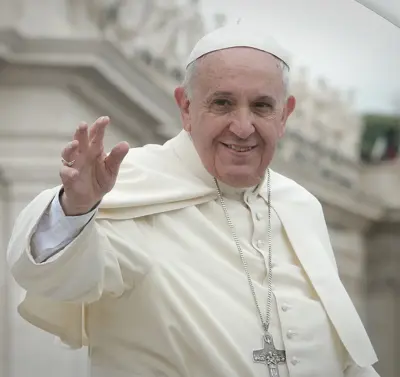
Pope Francis is the head of the Catholic Church and sovereign of the Vatican City State. Francis is the first pope to be a member of the Society of Jesus, the first from the Americas, the first from the Southern Hemisphere, and the first pope from outside Europe since Gregory III, a Syrian who reigned in the 8th century.
