Walter Russell Mead Quotes
The rejection of the scientific consensus on climate change is one of the many examples of populist revolt against expert consensus in the United States today.
Walter Russell Mead, Editor-at-Large of The American Interest, Co-founder of the New America Foundation, Council on Foreign Relations, “The Tea Party and American Foreign Policy”, Foreign Affairs, March / April 2012
Sourced by: Eigen's Political and Historical Quotations


For an example of what Senator Jeffords was referring to, see {610719}.


This is a classic technique used by politicians of the left and right when they are faced with scientific findings that do not comport with their ideological, religious, or political view of the world. Namely to point out that the science is not settled and the field is still in flux. Therefore, they are, that it si too early to make public policy on the basis of that. And they have little trouble finding that the scientists themselves who did the research that they do not like are the first ones to say that the science is in flux. For ALL SCIENCE IS IN FLUX and new findings are being introduced literally every day in most scientific fields. That very rarely does the new knowledge contradict the older science in huge and dramatic ways. Einstein’s Theory of Relativity turned the field of physics and mechanics upside down but it did not change the calculations that engineers and scientists would make in over 99 percent of their measurements. Within a few decades of Einsteins theory being published, it was demonstrated to be wrong—not completely wrong, but inadequate to measure the mechanics of tiny partials like electrons adn quarks. Quantum mechanics was born. And every week or so these days there is more knowledge that makes slight changes in the way we understand quantum mechanics. No science has ever remained settled for 1000 years since the beginning of scientific inquiry, By the 19th century most science did not remain settled for 100 years. In the 20th century “settled” science rarely lasted more than a decade, and in the 21st century, few are stable for even a year.


Most environmentalists worried about the global warming problem have one basic solution they want the world to adopt. Reduce the carbon footprint by reducing the amount of fossil fuels that we use. However, there are other techniques that are possible and are looking increasingly cost beneficial. But those worried about climate change tend to want to steer public discourse away from other solutions. They worry that if technologists like Myhrvold propose other solutions that may be credible, that will give the politicians of the world a rationalization for stopping the progress on reducing use of fossil fuels and political momentum would be lost with no certainty that these other technologies would be effective or worse whether the politicians would ever appropriate the moneys to give them a try and we would be left with nothing changing and the world warming with all the negative consequences therefrom.


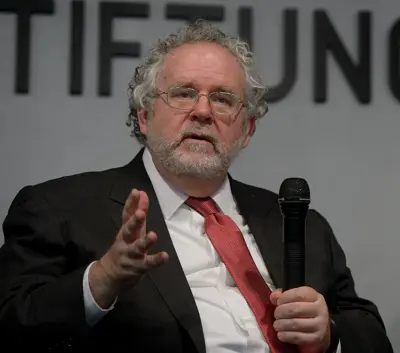
Walter Russell Mead is an American academic. He is the James Clarke Chace Professor of Foreign Affairs and Humanities at Bard College and taught American foreign policy at Yale University. He was also the editor-at-large of The American Interest magazine. Mead is a columnist for The Wall Street Journal and a scholar at the Hudson Institute.
