Theodore Roosevelt Quotes
The reigning conservatives in the House and Senate felt a relief that they did not try to conceal at the fact that I was not to remain as President.
Although Roosevelt was the most popular American president since George Washington, the right wing of his own party hated him. He had pledged not to run for a 3rd term and his 2nd was close to ending.
Theodore Roosevelt, 1858-1919, 26th President of the United States (Republican, NY), Statement to the British Ambassador, Whitelaw Reed, May 25, 1908
Sourced by: Eigen's Political and Historical Quotations

At the time of this quotation, Thompson was campaigning for the Republican Presidential Nomination for which he did not make a good showing in the primaries.

Periodically in American history, there has been a struggle between the Executive Branch and the Senate for dominance. The Senate’s power is negative however. It can block things, but cannot directly make them happen. The President can do both.


Actually, it was the Tea Party members of the Republican Party whose unprecedented willingness to risk the full faith and credit of the United States when the majority of the Republican legislators and almost all the Democrats were not, who held the required Debt Ceiling Increase hostage to getting their legislative way. But in this particular debate and legislation the Democrats gained nothing except that the anger of the American People was much greater against the Republicans than the Democrats, many of whose usual supporters thought that the Democrats had been totally intimidated by the Tea Party.


Benton's solution was for the people to elect the President and Vice President directly.


What if you are a conservative in a liberal environment? Then what you are conserving is liberalism.
His reference was to his experience as an undergraduate at Dartmouth, which he and associates views as a liberal organization, while others viewed it as a conservative bastion of the establishment.

What is fascinating about this quotation is that although the head of a religion, Smith was not advocating the kinds of personal lifestyle issues of his church the way modern religious leaders do, but was concerned with the much larger issues of expansionism, corruption of the courts and judiciary, and land distribution. He was a classic reform candidate in that sense. Smith had written to most of the then likely Presidential candidates of both major parties asking for their position on the Mormons who were facing persecution wherever they went. None of the politicians would make any satisfactory commitments. Smith took Direct Action and became the only major religious official to have run for the Presidency of the United States until Pat Robertson tried and failed in 2000. Smith’s assassination shortly thereafter cut his run for the Presidency short before it made much headway and politically he had no chance to affect the race.

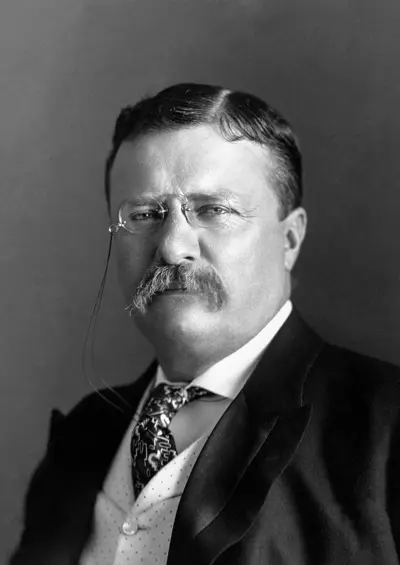
Theodore Roosevelt Jr., often referred to as Teddy or his initials T. R., was an American statesman, conservationist, naturalist, historian, and writer, who served as the 26th president of the United States from 1901 to 1909. He previously served as 33rd governor of New York from 1899 to 1900 and the 25th vice president of the United States from March to September 1901. Roosevelt emerged as a leader of the Republican Party and became a driving force for anti-trust and Progressive policies.
