Woodrow Wilson Quotes
The question of armaments, whether on land or sea, is the most immediately and intensely practical question connected with the future fortunes of nations and of mankind.
Wilson, Woodrow. The Papers of Woodrow Wilson. Edited by Arthur S. Link, vol. 35, Princeton UP, 1980, p. 433.


That was an ironic statement. Shortly thereafter we invaded Mexico, occupied the country, pressured it into “selling us much of what is now the Southwest of the United States, and finally left.


Samuel Langhorne Clemens, 1835-1910. His view was that the quality of statesmanship at the time was bellicose and imperialistic. We had annexed Puerto Rico and Cuba and then occupied the Philippines. He argued that if we did not have the bombastic and expansionist statesmen like McKinley and Theodore Roosevelt, we would not need so much armament to back them up.

This was written when the United States was not a dominant military power. At the beginning of the 20th century, the U. S. had the same size military as Argentina. It was France, German, Turkey and England who had the military superiority and it was they who tended to find excuses for war. After WWII, the U. S. was dominant and was involved with a number of wars and military incursions, often with nations that had not attacked the U.S. Korns’ principle was most dramatic when the George W. Bush administration invaded Iraq on the excuse that the Iraqis were developing weapons of mass destructions and then might attack the United States. After the successful invasion, the excuse was shown to be hollow as there were no signs of sophisticated weapons development.


He was exactly right. See {642079} for a perfect example of this prediction.


The atomic bomb had just been used the year before. However, in the next decades, nuclear weapons were not used again as those nations with nuclear capability also had potential enemies with nuclear weapons. The fear of Mutually Assured Destruction prevented nuclear weapons from being used for a long time.


There were many who thought that the Russians would view the Mutual Security Act as aggressive and they might respond with some kind of aggressive retaliation and this could lead to war. Others felt that containment would reduce the likelihood of war.


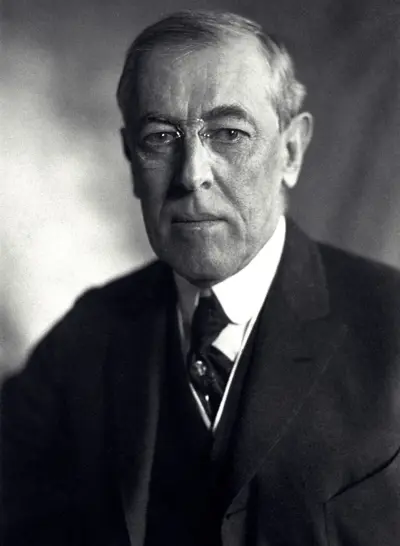
Thomas Woodrow Wilson was an American politician and academic who served as the 28th president of the United States from 1913 to 1921. A member of the Democratic Party, Wilson served as the president of Princeton University and as the 34th governor of New Jersey before winning the 1912 presidential election. As President, Wilson led the United States into World War I in 1917. He was the leading architect of the League of Nations, and his progressive stance on foreign policy came to be known as Wilsonianism. Scholars have generally ranked Wilson in the upper tier of U.S presidents, although he has been criticized for supporting racial segregation and white supremacy.
