John Ramsay Mculloch Quotes
The quantity of industry therefore not only increases in every country with the increase of the stock or capital which sets it in motion; but, in consequence of this increase, the division of labour becomes extended, new and more powerful implements and machines are invented, and the same quantity of labour is thus made to produce an infinitely greater quantity of commodities.
John Ramsay Mculloch,1789-1864, Scottish Political Economist & Statistician, “Political Economy,” Supplement to Encyclopedia Britannica
Sourced by: Eigen's Political and Historical Quotations


Statements like this caused some to believe him a Marxist, but see his quotation on Karl Marx -- {603061}.

This is a classic illustration of a quotation illustrating the problem that political discussions have with the issue of causality. Conrad is absolutely correct in stating that investment and innovation as the direct cause for most productivity. However, without the demand created by consumption (or the prospect of it) there will be little capital and effort at innovation. There is a causal chain and different ideological proponents argue for their preferred link in the chain tending to ignore the other links. Many liberals tout increasing consumption and pay little attention to the investment and innovation—an error of the opposite of Conrad’s.


At the time Vidal, who shared this view with many economists, had no inkling of the digital revolution that the PC and Internet would bring, nor the other phenomena that eliminated the need for cheap labor — robotics and offshoring. Nor could he have foreseen the development of fracking making America virtually energy independent as it was before WWII. It appears that the problem has shifted from Vidal's issues, to that of what do we do with the American citizens who do not have advanced skills nor do we have methods of educating them and training them to this level. The quotation illustrates that it is always difficult predicting the future, but particularly hazardous when it comes to economics.

Ironically, Fitzhugh who detested socialism, held this basic socialist principle. His solution however, was that the profits were necessary for society, and therefore slavery was the solution for Blacks AND whites.


This quotation is historically important because it documents the radical change in agriculture that technology brought on. In this period it was steam power. There were steam powered tractors in addition to what he enumerated. The production cost and hence the prices of agricultural products became much lower increasing the standard of living for all consumers. However, the small farmer, without capitol and the scale of a large enough farm, was put in a position in that he could not compete with the major products of agriculture without huge investment in capital equipment and large enough farms. While many went out of business, many others shifted to specialized crops and raising animals where the automation was not as necessary. This process has been on going in American agriculture since the invention of mechanized farm implements, and the small farmer has gradually become more rare. But the process has been ongoing throughout American history.

Samuel Langhorne Clemens, 1835-1910


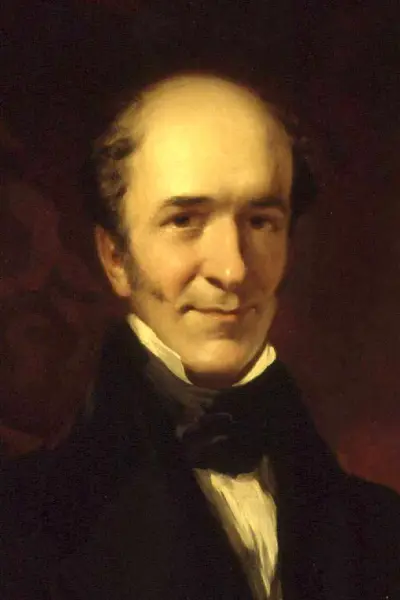
John Ramsay McCulloch was a Scottish economist, author and editor, widely regarded as the leader of the Ricardian school of economists after the death of David Ricardo in 1823. He was appointed the first professor of political economy at University College London in 1828. He wrote extensively on economic policy, and was a pioneer in the collection, statistical analysis and publication of economic data.
