Lee Kuan Yew Quotes
The poor are making themselves poorer through rising birth rates.
Lee Kuan Yew, Prime Minister of Singapore, “Laissez-Faire Procreation,” Foreign Policy September/October 2005
Sourced by: Eigen's Political and Historical Quotations

In Burundi, family land is divided among the male children of a family. The average Burundian woman has 6.3 children, nearly triple the international fertility rate. With this fertility rate, the plots of land for each person inevitably get smaller and smaller over time. At 10,745 square miles, Burundi is slightly smaller than the U.S. state of Maryland, but it holds nearly twice as many people: about 10 million. The small plots of land are inefficient to farm and provide subsistence. So the nation was in a crises as there was little industrialization and land was essential for existence for most Burundians. See {35808} and {35809}.


As an example, if a woman is of childbearing age and does not pick up her regular subscription for birth control pills, the government requires that a phone call be made to the woman to “remind” her.


Despite the obvious benefits of family planning, there are a number of religious forces which see abortion and contraception as the same immoral act—the terminating of a life or potential life. This view is held by most clerics who are Orthodox Jews, Fundamentalist Protestants, Roman Catholics, and fundamentalist Muslims. The members of those religions however, do not always agree with their clergy. For example, the majority of American Catholics practice Birth Control as do many modern Muslims, most protestants and most Jews.

One of the most contentious activities in all political history is a government trying to regulate the number of children which its citizens can have. When a government tries to do this, they run into opposition by some religious people who oppose birth control in general or some birth control methods (eg abortion). In addition it is opposed by many people who do not want the government involved at all in a decision that is so personal. Yet many governments, under the press of perceived overpopulation, or in an effort to limit mental retardation, have attempted such regulation and that includes the United States where 40 states have at one time or another practiced forced sterilization of people who the state believed were unfit to bear children. China and India—the largest nations of the world—have both maintained government policies and practices to control population with China making it illegal to have more than 1 child. These programs have reduced the population counts, but at a terrible ethical cost and resentment of the affected people.

At the time most people did not realize that the ability of a nation or land area to support a population was dependent more on agricultural and industrial productivity than on population size. In the most affluent and developed countries, land outside of the cities is quite affordable and available, whereas in poor, underdeveloped nations, land distribution and reform is still a factor. The majority of citizens of many developed, affluent nations do not own any land.


History has shown that as girls and women get educated and learn about family planning, their children are healthier and have better chances of survival and despite the lower death rate the population trend slows as a result of family planning.

Malthus was of the view that population growth often eclipsed the capacity of government and private institutions to support the population. There are even today nations and subpopulations where the economic growth is reasonable but the population growth is greater so that at the end of each year, the average person is poorer and has a lower standard of living. What Malthus did not anticipate is the remarkable productivity growth rate of those institutions like American agriculture, which allo`ws many more people to thrive within a fixed geographic area.

One dramatic example of this principle is that India at the end of the 20th century had more billionaires than the United States did.
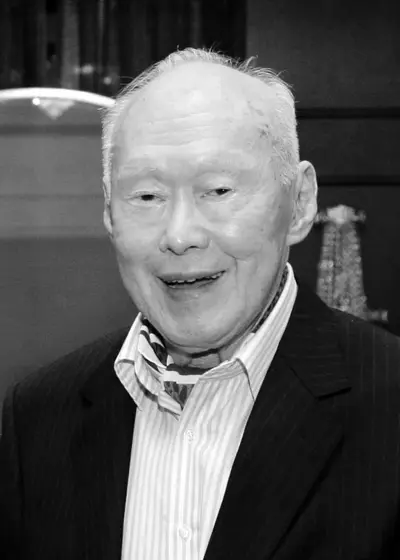
Lee Kuan Yew GCMG CH SPMJ, often referred to by his initials LKY, was a Singaporean statesman and lawyer who served as Prime Minister of Singapore from 1959 to 1990. As one of the founding members of the People's Action Party, Lee is recognised as the nation's founding father, credited with rapidly transitioning the country from a "developing third world country into a developed first world country within a single generation" under his leadership. Lee died of pneumonia on 23 March 2015, aged 91. In a week of national mourning, about 1.7 million Singaporean residents as well as world leaders paid tribute to him at his lying-in-state at Singapore's Parliament House and at community tribute sites around the country.
