Mikhail Gorbachev Quotes
The party cannot relinquish its leading role in the economy.
Mikhail Gorbachev, Russian President, Speech, June 26, 1987
Sourced by: Eigen's Political and Historical Quotations


His “Real Plan” had stopped the Brazilian hyperinflation when he was Finance Minister.


There have always been economic and political ideologues. However in the George W. Bush administration ideological purity was a key criterion for appointment, and many appointments were made of ideologues who had no experience and had accomplished little previously. This quotation was a criticism of the unfettered free market ideology of so many of the Bush appointees. Critics like Bernstein saw this ideological focus as opposed to pragmatism, as responsible for the poor economic record of the Bush administration. Apologists for Bush and conservative economic ideology attribute the economic problems to cycles over which the administration and government had little control.

1st Viscount Snowden. Nationalization is when a nation or state determines that certain industries of areas of the economy should be reserved for the government to operate. Private companies, if they have been operating a nationalized industry losse their rights to continue in that business and may even lose their physica assets in which case th form is supposed to be paid a fair price. In 21st century America we have very few nationalized industries. One of these is the manufacture of nuclear weapons. Communist counties have many if not most of the economy nationalized. From the 19th century socialism has evolved from a belief that most people will best be served by nationalization of most of th major economic functions. However, over time this did not meet Socialism’s other objectives and nationalism became less popular with socialists. Snowden, a leading socialist, wanted to get rid of the concept entirely, and today there are very few situations where there are calls for nationalis. Even the few remaining communist nations are privatizing (the opposite of nationalizing) some of their economy.

This quotation illustrates White’s favorable view of Russia. Note his use of the “it works” phrase which he picked up from Stefens’ famous quote {634892}. At the time the Soviet Union had been perceived by many economists to have been a great economic improvement over Czarist Russia. And over all, Russia which in 1917 was an economic basket case, had become one of the stronger states in Europe although the Russian people paid a horrendous price. Most historians agree that White passed classified information to the Russians. He was accused of being a Communist, but there was never any evidence of that. Some people believe that he was a spy for the Russians and committed espionage, but others disagree observing that White was very much his own man and felt that much information that was classified never should have been. White substituted his own judgment, it is believed, about what could be given to the Russians for the security system. He was an admirer of what Russian socialism had accomplished economically, educationally and medically since the 1917 revolution deposing the Czar. Russia had been a valuable military ally, which had taken the brunt of both military and civilian casualties in WWII. White’s economics were certainly not Marxist but very much Keynesian. He was subpoenaed by the House Un-American Activities Committee where he was accused of being a Communist which he denied (see {634907}). He died of a heart attack 3 days later.

At the time extreme socialist doctrine was that the state should own the factories and the other means of industrial production. The socialists believed that the people through their government had to be able to control the economy and the private owners’ greed would always drive the economy for themselves and not for the society in general. Deal was one of the first who argued that there were other, less draconian modes of economic control like government regulation and central banks. Deat turned traitor during WWII and served in the Vichy Nazi cabinet of Pierre Laval. He was sentenced to death for treason but escaped to Italy where he assumed a new identity and then was sheltered by a right-wing Catholic religious order in the convent of San Vito, near Turin, where he wrote his memoirs and lived undiscovered until his death.

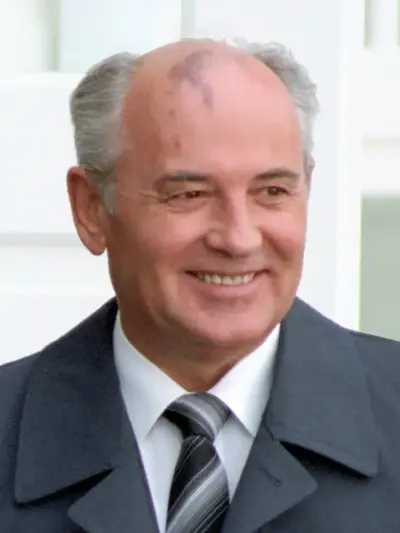
Mikhail Sergeyevich Gorbachev is a Russian and former Soviet politician. The eighth and last leader of the Soviet Union, he was the General Secretary of the Communist Party of the Soviet Union from 1985 until 1991. He was also the country's head of state from 1988 until 1991, serving as the chairman of the Presidium of the Supreme Soviet from 1988 to 1989, chairman of the Supreme Soviet from 1989 to 1990, and president of the Soviet Union from 1990 to 1991. Ideologically, Gorbachev initially adhered to Marxism–Leninism, although he had moved towards social democracy by the early 1990s.
