George Gaylord Simpson Quotes
The opposition to teaching evolution is, of course, almost always given a religious reason. That may usually be its real basis, but I think it is often a mask, perhaps unconscious, for underlying anti-intellectualism or antiscientism.
Simpson, George Gaylord. This View of Life: The World of an Evolutionary Biologist. Harcourt, Brace & World, 1964, p. 231.


In September, 2007, Vitter earmarked $100,000 in federal money for a Christian group, the Louisiana Family Forum, known for challenging evolution by means of "teaching the controversy" which promotes intelligent design. When the earmark became public, other legislators pressured Vitter to withdraw is earmark which he did in October of 2007. Vitter had been a major opponent of spending federal money for education, but made an exception for this project. Vitter’s hypocrisy extended to his own behavior as well. See {625898}.


Conflict between religion and evolution does not exist in most churches. There are exceptions of some orthodox Jews, fundamentalist Christians and Muslims. However, in this case the highest prelate of the American Episcopal Church not only sees no conflict but urges that evolution be taught in schools.

In a policy statement relegating non-evolution theories of origin such as creation science to the social science and language arts curricula:
This quotation is a good example of what a substantial number of Americans believe and the classic errors they make in acting on their views. The vast majority of the religions in America have no conflict with evolution. To them evolution is the method that God chose to create the life on earth. Some fundamentalists take the Old Testament versions of the creation of the earth and man (there are 2 of them that conflict) literally by which they conclude that the earth is 6,000 years old or so. In reality, the earth is over 10 Billlion years old but the scientific evidence that proves this as well as evolution via natural selection is almost always not known to them. It is not as if they have studied it an rejected evolution. Almost all have never studied it. As a result they think that the word “Theory” means an unproven hypothesis which is the lay, non scientific meaning of the word. But in science, a theory is large set of related proven laws or principles, that has been tested over and over again and for which there has NEVER been a counterexample proven. A theory does not explain everything in the area and additional hypotheses are constantly being tested and if they stand up are added to the theory. And there are areas that are not explained by a theory, and these may or may not be in the future, but no theory does or can explain everything. Brattin, who sadly has never been educated about the science of biology, believes that it is a scientific theory is a “belief structure” like a religion. However, to qualify as part of an established scientific theory the statements must have been subjected to demonstrative proof, usually by many different scientists typically using many different methods. And these results must be replicated over and over again. No religion can be proved the way a scientific theory can be and that should not surprise anyone as religion is in the domain of faith where science has not the methodology to validate or invalidate people’s religious beliefs. Likewise, religion has not the methodology to prove or disprove science not should it be expected to. Many scientists are religious and many are not. Many religious people are scientists and many are not. They have little to do with each other.


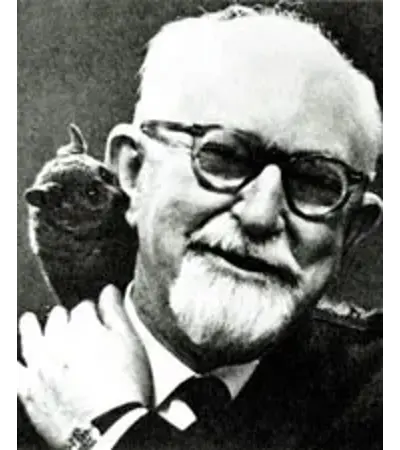
George Gaylord Simpson was a US paleontologist. Simpson was perhaps the most influential paleontologist of the twentieth century, and a major participant in the modern synthesis, contributing Tempo and Mode in Evolution (1944), The Meaning of Evolution (1949) and The Major Features of Evolution (1953). He was an expert on extinct mammals and their intercontinental migrations. He anticipated such concepts as punctuated equilibrium (in Tempo and mode) and dispelled the myth that the evolution of the horse was a linear process culminating in the modern Equus caballus. He coined the word hypodigm in 1940, and published extensively on the taxonomy of fossil and extant mammals. Simpson was influentially, and incorrectly, opposed to Alfred Wegener's theory of continental drift.
