Mahathir Mohamad Quotes
The only way to manage our economy is to insulate us from currency and stock market speculators—and that is to take the foreign exchange from them.
Mahathir Mohamad, Prime Minister of Malaysia, Announcement placing restrictive currency controls and unpegging Maylaysian currency to the dollar, September 1, 1998
Sourced by: Eigen's Political and Historical Quotations


Currency Pegs are policies and commitments that countries make to sate that their currency henceforth will have a fixed relationship to another currency—usually the American Dollar, the English Pound or the Euro. If a second and even more countries also agree to peg their currency to the same, then the counties who are pegging can trust each other’s currency providing economic stability and facilitating trade.


The States sold bonds to finance the their efforts in the Revolutionary War. Some states had better prospects for redeeming their bonds than others. Georgia, South Carolina and North Carolina in particular had poorer prospects than most and their bonds were selling at about 25 cents on the dollar. Alexander Hamilton, then the Secretary of the Treasury, wanted the new Federal government to assume the state’s war debt and pay off the bonds. He made his proposal for how he would accomplish this on January 14, 1790. He delivered his report and proposal to Congress “Report on the Public Credit”. As soon as Hamilton’s proposal was read in Congress, sophisticated speculators set off for the Southern States to buy up as many bonds as they could before the owners found out that a Federal bail-out was under serious consideration. They could easily double, triple or even quadruple their money. Many congressmen wanted to outlaw the speculation. See {619929} & {619939}. The pro-speculation forces got their way. Some speculators made fortunes. Most bondholders lost money.


Iceland's economy collapsed in the Meltdown of 2008. Their largest banks failed completely as they had engaged in the same kind of risky investments as the American banks had. Their government however did not have the assets to bail their banks out. So they let the banks fail and protected the small depositors with their limited assets. They then devalued their currency drastically, making their fishing and other products a great bargain for other nations of the world and though humiliated the Islanders started getting jobs as demand for Islandic exports grew. Some Icelanders who owned companies were making a great deal of money. Taxes were raised for high income citizens. To prevent the money being taken out of the country and invested so that the jobs would not benefit Icelanders or the earnings were not as taxable in Iceland, the nation imposed Capital Controls—no money was allowed to be taken out of the country except small amounts for business travel expenses. Iceland recovered rapidly and by 2015, at which point the Minister of Finance felt that the country was losing more than it was gaining, so it was time to end the Capital Controls.


The first of these safeguards was abandoned during the George W. Bush administration and the economic meltdown of 2008 resulted. The Obama administration in 2010 restored some regulation of banks and investment banks.

FDR was then a candidate for the Democratic Vice Presidential Nomination. This statement shocked some of the conservative French and British delegates and officials such as Ramsay MacDonald, Georges Bonnet, and Neville Chamberlain, but economist John Maynard Keynes strongly approved of Roosevelt Roosevelt’s statements. At issue was whether or not the major currency powers should confer frequently and set the international currency exchange rates or should the rates float and be determined at any point by the free market in currency. FDR held the latter view which was opposed to the positions of the conservative banker-oriented delegates from the European counties, However Roosevelt’s statement was considered “harsh” and “vituperative” by the conservatives and the entire conference collapsed over them. FDR admitted that perhaps he had been too strong and blunt in his language. An irony of this quotation is that 80 years later the positions of liberals and conservatives had both flip-flopped. It became the conservatives who adopted the FDR free market for currency exchange while many liberals called for government intervention and agreement on exchange rates to prevent instability.
The Hoover administration had lost control of the economy. The nation was in a depression. Banks were failing. Gold was being hoarded and taken out of circulation while we were on the gold standard. Roosevelt’s solution was to decouple American money and gold—a solution that William Jennings Bryan had suggested many years earlier. See {640978}.

Keynes was suggesting a small transfer tax on securities and other financial instruments. For investors, such a tax would not be a significant burden, but it would discourage pure speculation. Generally every one likes that idea except the speculators. They in turn, play off one nation or jurisdiction against the others by threatening to take their stock and bond markets to other nations which do not have such a tax. That has worked for almost a century in avoiding such a tax in the United States which is the center for both world investment and speculation.

There have always been economic and political ideologues. However in the George W. Bush administration ideological purity was a key criterion for appointment, and many appointments were made of ideologues who had no experience and had accomplished little previously. This quotation was a criticism of the unfettered free market ideology of so many of the Bush appointees. Critics like Bernstein saw this ideological focus as opposed to pragmatism, as responsible for the poor economic record of the Bush administration. Apologists for Bush and conservative economic ideology attribute the economic problems to cycles over which the administration and government had little control.


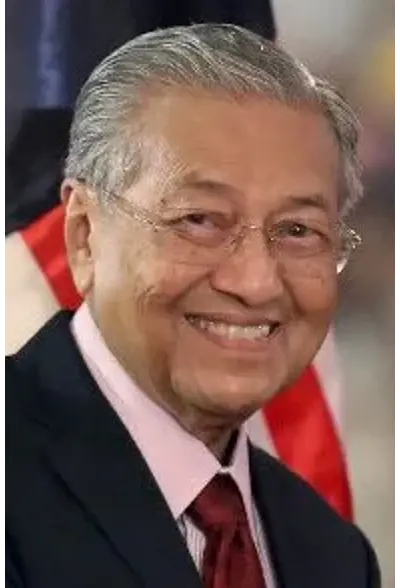
Tun Dr. Mahathir bin Mohamad is a Malaysian politician, statesman, author and doctor who served as the 4th and 7th Prime Minister of Malaysia from July 1981 to October 2003 and again from May 2018 to March 2020. He served as the 4th Deputy Prime Minister and in many other Cabinet positions before his promotion to the premiership in July 1981. He has served as the Member of Parliament (MP) for Langkawi since May 2018, Kubang Pasu from August 1974 to March 2004 and Kota Setar Selatan from April 1964 to May 1969. His political career has spanned more than 70 years, starting with his participation in protests against non-Malays gaining Malaysian citizenship during the Malayan Union through to forming his own political parties, the Malaysian United Indigenous Party (BERSATU) in September 2016 and the Homeland Fighters' Party (PEJUANG) in August 2020.
