Stephen Cambone Quotes
The office has oversight of people who do analysis and oversight of people who do operations, but it is not charged with doing either. That is an important point to make. Those functions are performed by the CIA, DIA and other agencies.
Cambone, Stephen. "Special Briefing on the Reorganization of the Office of the Under Secretary of Defense for Intelligence." U.S. Department of Defense, 8 May 2003.


Intelligence agents tend to prefer covert activities to the less dramatic, non-exciting, activity of gathering and analyzing intelligence. Most national intelligence services tend to enlarge their portfolio to include covert activities regardless of what the national leaders intended. Because of the secrecy, they can often get away with this.

Expressing concern over President Obama extending some of the American citizen entitled privacy rights to foreigners. He was concerned that this might inhibit our spying efforts.

When Bob Casey was the CIA Director, he the declassification of all the operational files of the WWII Office of Strategic Service. The huge collection is referred to as Record Book 2.6


The major idea of intelligence agencies in a democracy is for the intelligence agencies to provide the policy makers with facts on the ground and data with which they can make sounder policies. However, many times the policies of the administration is so firm that the political ideology restrict not only the kinds of analysis the intelligence agencies do, but in some cases shape or control the conclusions of otherwise sound studies. The influence of Vice President Cheney on the CIA and the invasion of Iraq.


The American Embassy in Berlin had wiretapped the telephone and telegraph wires of the German Foreign Ministry. The man who did that was hired by Secretary of State Lansing as the first employee of the new unit.

He was the Chairman of the Senate Judiciary Committee. The NSA had hacked into the servers of these firms and others that were located out of the country. (They would need to have a warrant if inside the country.) The companies had never known it until Edward Snowden made this practice public. The result was, the public was learning that there was no privacy in any of their e-mail, social media activity, exchange of photos or videos or anything else. The companies feared that this would then harm their business, and that the techniques NSA used to hack there servers would then be discovered and used by others to steal identities, credit cards and do such other damage to customers. Even if the particular hacking methods were not leaked to the bad guys, they, knowing that the servers were vulnerable, would be encouraged to work to figure it out.


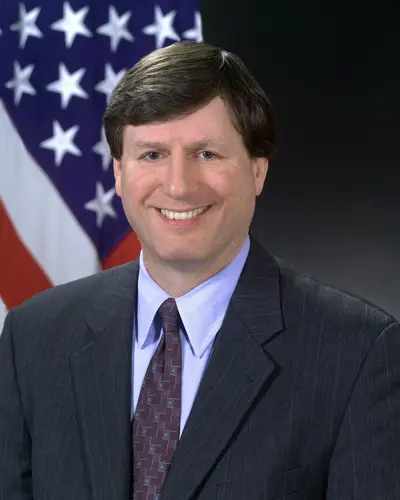
Stephen Anthony Cambone was the first United States Under Secretary of Defense for Intelligence, a post created in March 2003. Cambone first came to the attention of the public at large during the testimony of Major General Antonio Taguba before the U.S. Senate Armed Services Committee, where he disputed the General's statement that prison guards were under the effective control of military intelligence personnel and interrogators. Cambone resigned at the beginning of 2007 and was replaced by James R. Clapper, Jr., former head of the Defense Intelligence Agency (DIA) and the National Geospatial-Intelligence Agency. Cambone was associated with the Project for the New American Century, participating in the study which resulted in the writing of the report Rebuilding America's Defenses.
