Gertrude Stein Quotes
The nineteenth century believed in science but the twentieth century does not.
Stein, Gertrude. Paris France. Charles Scribner's Sons, 1940.


Most scientists do not have the skill or the totality of knowledge to accurately predict the effect of scientific research and learning on society. Many are not interested. Those who try to communicate with politicians and the public are usually met with indifference or suspicion. Above all, the scientific and mathematical literacy of the public is so weak, that it is impossible in much of science to even explain the science to the lay public much less explain its implications. Soddy was a bit of an idealist from a class society and he felt the upper classes should be better informed by scientists.

10 centuries ago was a time when the Arabs were far more advanced and modern than other cultures including the Christian West that was in the Dark Ages. However, in the 12th century there was a “closing”—a narrowing of allowable Islamic thinking, and since then, Islamic people have had great difficulty with change or modernity. Not all Muslim nations are equally rigid but the Arabs are at the extreme among Islamic counties.

Much of modern science involves non-intuitive concepts that can rarely if ever be discovered using common sense. It was hard enough for most people to accept the notion of an infinite number, but now we know that there are many infinite numbers and they are all different form one another. Darwinian thinking was contrary to most learned thought of the day, and even much public opinion today. Even Albert Einstein had to struggle to comprehend the findings of Quantum Mechanics which are very non intuitive—one object can be in two different places at the same time. Meanwhile, most people are totally unaware that the world around is does not correspond to normal human intuition and common sense. Yet these are the same and only tools that we continue to use in making decisions about our society. And the fundamental truths of yesterday, the foundation of past thinking and glory, are the naïve simplifications and errors of today and become the superstitions of tomorrow.

By “arts” Jefferson meant the mechanical arts—inventions and engineering. Jefferson Extrapolated the science and technology progress at the time to the future in a way that few others did at that time.


This characteristic of science causes the politicians great difficulty when allocating public funds for scientific research. It is often very hard to attribute credit to the right scientist when a scientist herself might not yet realize the great significance of her work. Of a number of different scientists each contributing one step of a process when the person who worked on the last link could not possibly have done it without the others along the way. Who to fund and why is terribly frustrating which is why the National Science Foundation and the National Institutes of Health make most of their funding decisions on the basis of proposals and peer review and decision making. None the less, many politicians are constantly trying to interject their preferences, almost always based on their ignorance, especially when they can get research funds into their district.


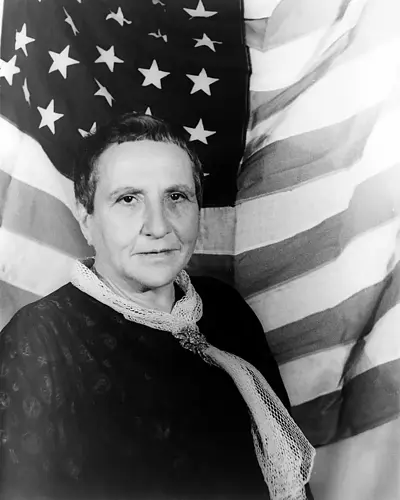
Gertrude Stein was an American novelist, poet, playwright, and art collector. Born in Pittsburgh, Pennsylvania in the Allegheny West neighborhood and raised in Oakland, California, Stein moved to Paris in 1903, and made France her home for the remainder of her life. She hosted a Paris salon, where the leading figures of modernism in literature and art, such as Pablo Picasso, Ernest Hemingway, F. Scott Fitzgerald, Sinclair Lewis, Ezra Pound, Sherwood Anderson and Henri Matisse, would meet.
