Edwin O. Reischauer Quotes
The most radical, one might even say Socialistic leader the United States ever produced.
Although very authoritarian in his governing style, the substance of the Constitution that and basic laws that he imposed on post war Japan were extremely left wing. Japan eschewed having a military, required total equality of women for the first time in Japanese history. The Civil Service was given great power and authority over business, there was a complete social safety net. MacArthur would not take kindly to this characterization as he thought of himself as a lifelong conservative and was the darling of the American right wing extremists. He took the American Constitution literally and was determined to turn ultra-militaristic Japan into a democracy. He did in one of the most dramatic cultural and governmental changes in history.
Edwin O. Reischauer, Historian & U. S. Ambassador to Japan, Assessment of General Douglas MacArthur and his Military Rule of Japan, Quoted in Lynne Olson, “Retreat and Advance”, New York Times Book Review, April 27, 2014
Sourced by: Eigen's Political and Historical Quotations

Supporters of medical reform include:

Liberal Supreme Court Chief Justice Earl Warren is:


The first quotation was made shortly after the launching of The Clarion in 1891. The newspaper was relatively successful but while England moved more to the left, socialism was not embraced by Englishmen. Later, Blachford concluded that the conversion would not likely take place soon.

This is not only attributed by reliable sources but apparently Roosevelt had said this on several occasions. The word “radical” has had different shades of meaning at different periods of American History. The origin of the word from the Latin means someone who wishes to change things very rapidly and not gradually. In the time of the Civil War, the majority of the Republicans proudly referred to themselves as “radicals” or “radical Republicans” because they wanted to abolish slavery immediately. In the late 19th century the word “radical” referred to anarchists. From the Russian Revolution onward “radicals” were communists who presumably wanted to change governments throughout the work through revolution—very rapid change. However, in the early 20th century, radicals were people who wanted to reform and regulate businesses and monopolies rapidly and it is this sense he was a radical. But by style, he was a radical in most things in that he wanted to change things and change them rapidly.

Ataturk was not receptive toward Communism as some other world leaders were at the time. He saw its weakness far earlier than many others.


He had asked a family friend not to bring books by Hemmingway into his home. The friend asked why and received this answer. Koch and his brother were the largest political contributors in the United States, so they had enormous influence on Republicans (they only made political contributions to conservative organizations).

Hoover, a brilliant administrator before his presidency, was so ideological about the role of government that when the Great Depression came, he was unwilling to use government directly to cope with the new problems. He was turned out of office in favor of FDR and the New Deal which the voters ratified 4 times. Hoover was embarrassed by the New Deal successes and lashed out with many insults. In this case, he called the New Deal “fascist”. See {589568} for another quote where he labels the New Deal communistic. Ironically, Hoover is rated by most historians as one of the least effective Presidents in American history while Roosevelt is always rated among the top 3 presidents.


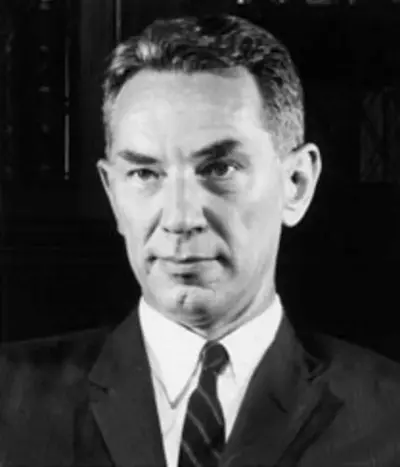
Edwin Oldfather Reischauer was an American diplomat, educator, and professor at Harvard University. Born in Tokyo to American educational missionaries, he became a leading scholar of the history and culture of Japan and East Asia. Together with George M. McCune, a Korean scholar, in 1939 he developed the McCune–Reischauer romanization of the Korean language.
