Noam Chomsky Quotes
The military has a huge role in the economy [of Pakistan] with big stakes and, as you say, it has constantly intervened to make sure that it keeps its hold on policy making. Well, I hope, and there seem to be some signs, that the military is taking a backseat, not really in the economy, but in some of the policy issues. If that can continue, which perhaps it will, this will be a positive development.
Chomsky, Noam. Global Discontents: Conversations on the Rising Threats to Democracy. Metropolitan Books, 2017.


There is frequently a disagreement between the military and civilian leaders just as there are disagreements among most political personnel. Hawks, and people who have had experience in the military tend to think that military advice on military matters should be determinative with the President and Congress. Others tend to believe that military advice should be considered, but if it were always adhered to, there would be no point in having civilian control over the military. See {639667} for an example of when military leadership advice prevailed and it was a mistake.

of the Chinese Kuomintang government under Chiang Kai-shek. The only soldier ever so honored
The only soldier ever so honored


Actually, many politicians and scholars disagree that population size heavily correlates with national influence in these areas. A good example would be Israel. It’s population is much smaller than the Arabs surrounding them. Yet their military is far superior; it’s economy is stronger and it is politically more influential that any of its Arab neighbors. The United States is smaller than Russia, India, and China; yet it is much more influential. Too large a population makes it harder to educate the citizens and costs the country much in terms of industry and military manpower.


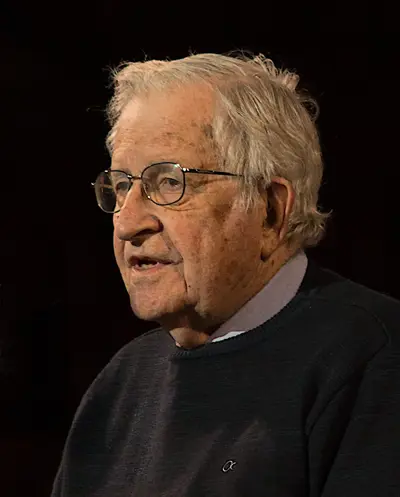
Avram Noam Chomsky is an American linguist, philosopher, cognitive scientist, historian, social critic, and political activist. Sometimes called "the father of modern linguistics", Chomsky is also a major figure in analytic philosophy and one of the founders of the field of cognitive science. He is Laureate Professor of Linguistics at the University of Arizona and Institute Professor Emeritus at the Massachusetts Institute of Technology (MIT), and is the author of more than 150 books on topics such as linguistics, war, politics, and mass media. Ideologically, he aligns with anarcho-syndicalism and libertarian socialism.
