Tariq Ramadan Quotes
The message of Islam asks you to be intellectually, spiritually, socially, and politically independent
Ramadan, Tariq. What I Believe. Oxford University Press, 2009.

One of the noteworthy aspects of this quote is a fundamental intellectual clash. Al-Quaeda and other Islamic fundamentalists are genuinely very concerned that the West will interfere with their religion and their desire to unite all the Muslims in the world. Ironically, the West prides itself on the tolerance of religion and the freedom for anyone to practice any religion. The West does not see where it is interfering at all with the Muslim religion or its moral precepts. The problem lies in the different perception of ideas. Since about 1100 there has been a closing of Islamic intellectual growth and change. Any idea which is contrary to the orthodox view of Islam is perceived as hurtful or at least dangerous to the Muslim. Individuals in the West question Islamic relation no more than different sects of Christianity, Judaism and other religions. Allowing freedom is not sufficient for this Islamic notion; there must be no exposure to different ideas or examples. For us, no exposure means no freedom. While there are many Muslims which agree with this position, there are also many who disagree completely and believe that Islam is strengthened by exposing Muslims to all the ideas in the world. He was killed by an American air strike that had targeted him.


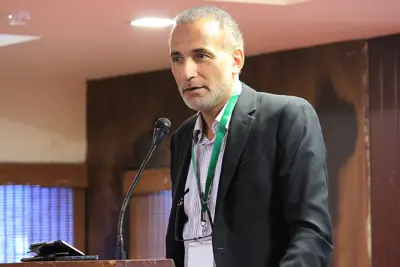
Tariq Ramadan is a Swiss Muslim academic, philosopher, and writer. He was a professor of contemporary Islamic studies at St Antony's College, Oxford and the Faculty of Theology and Religion, University of Oxford, but as of 2018 is taking an agreed leave of absence. He is a visiting professor at the Faculty of Islamic Studies at Hamad Bin Khalifa University in Qatar, and the Université Mundiapolis in Morocco. He is also a senior research fellow at Doshisha University in Japan. He is the director of the Research Centre of Islamic Legislation and Ethics (CILE), based in Doha. He is a member of the UK Foreign Office Advisory Group on Freedom of Religion or Belief. He was elected by Time magazine in 2000 as one of the seven religious innovators of the 21st century and in 2004 as one of the 100 most influential people in the world and by Foreign Policy readers (2005, 2006, 2008–2010, 2012–2015) as one of the top 100 most influential thinkers in the world and Global Thinkers. Ramadan describes himself as a "Salafi reformist".
