Harry S. Truman Quotes
The main difficulty with the South is that they are living eighty years behind the times and the sooner they come out of it the better it will be for the country and themselves. I am not asking for social equality, because no such thing exists, but I am asking for equality of opportunity for all human beings and, as long as I stay here, I am going to continue that fight. When mob gangs can take 4 people out and shoot them in the back, and everybody in the country is acquainted with who did the shooting and nothing is done about it, that country is in pretty bad fix from a law enforcement standpoint … I can't approve of such goings on and I shall never approve it, as long as I am here, as I told you before. I am going to try to remedy it and if that ends up in my failure to be reelected, that failure will be in a good cause.
At the time, there was not only racial discrimination, especially in the South, but lynching—the relatively public and open killing of Blacks and other forms of racial violence were commonplace in Southern America. Truman, himself a Southerner, was considered a traitor by many Southerners because he tried to deal with the Civil Rights problem more vigorously than any previous president. The Democratic Party had “the solid South”—political control of the Southern States and there was an unwritten rule that the Party positions and leaders would not push Civil Rights and would support States rights in law enforcement. The Republicans, in the Lincoln tradition, fought hard for Civil Rights enforcement but were the minority. Truman integrated the armed forces and did what he could do via Executive Orders but could not get any laws through the Congress. When LBJ pushed the Civil Rights Bill through Congress, Southerners became Republicans and the South was solidly in the Republican camp.
Harry S Truman, 1884-1972, 33rd President of the United States (Democrat, MO), Letter to his good friend Ernie Roberts, August 18, 1948
Sourced by: Eigen's Political and Historical Quotations

This was art of the Nixon "Southern Strategy" to alienate the white supremacists and racists from the Democratic Party with Civil Rights legislation and rhetoric, and get most of them to become Republicans. But as Phillips observed, when Negroes began voting in significant numbers in the South the party switching really accelerated.


Moynihan was actually not the political originator of the "benign neglect" phrase which became so controversial. It had been first used by The Earl of Durham in his 1839 Durham Report on the English policy towards Canada.

This painting depicted a young black girl walking to school surrounded by 4 U. S. Marshalls protecting her from the crowd of white racists trying to prevent her from attending an elementary school under court order. The vicious race hatred that school integration revealed was the national problem that was then surfacing. The graphic is the illustration that appeared in Look with that name.

Smith, an extreme racist, was so rabid that MacGregor was supporting the Civil Rights Bill, he followed him off the House floor to make this statement. MacGregor jokingly told Smith that he was wrong. He had 17 Negroes in his District.


Amazing as it is to most Americans today, the first time there was an interracial kiss depicted on television was on the Science Fiction TV Show Star Trek in the late 1960s. Although the public reaction was not as hostile as the television executives and politicians of the time feared, there were organized boycotts of NBC and many death threats to the actors, writers, producers and executives.


Booker T. Washington was a Black leader who did much for his people, but his objectives were quite limited. He was “the white’s favorite Black man.” Du Bois not only took on the White establishment but the Black establishment as well.

Wilson, a history and government professor and college president before politics, was has been accused of being one of the most racist Presidents since Reconstruction. Prior to his Presidency, the Federal Government had been making steady progress in hiring African Americans. Under Wilson there was a wholesale firing of a large proportion of them. Some apologists argue that his League of Nations and other major aspirations required the votes and cooperation of Southern Senators who insisted that many of the blacks be terminated. At the same time, the KKK was near the zenith of its membership and political power and was an intimidating force. Wilson’s home state of New Jersey not only had a large KKK membership but there were lynching of Blacks in his own state and when Governor and President he never asked for any anti-lynching legislation.


Blacks were fighting and dying in WWII. They were equal when they were under fire, but otherwise not. The war was against fascist protagonists whose creed was inequality while the allies were upholding freedom and equality. But making that aspiration a reality was difficult.

the white Southern racist system She was one of the first prominent white southerners to denounce racial segregation.


Incredible as it seems today, no Black person had ever dined in the White House as a guest of the President. African American servants were common. And Abraham Lincoln had received many Black visitors as had Presidents after him. But no president had ever had a Black person to dine as a social equal. The photo, reproduced here, illustrates the parity. But that was the worst thing a President could do so far as Tillman and his fellow racists were concerned. They had, since the end of the Civil war, used violence and terrorism to murder, maim and/or intimidate the Negro population to remain in an economic and socially inferior position. In Tillman’s state over these decades they had more lynchings than legal executions and there were plenty of them. Newspapers over the South riled up the whites and there was a wave of terror to be sure that the President’s importune action would not be taken as an endorsement of the Negro’s right to any equality or even dignity. This dinner essentially wedded all the Blacks to the Republican Party and all the Southern Whites to the Democratic Party. This would remain the political situation for over 60 years until the Democrats passed the LBJ Civil Rights Act in 1964 and the Republicans decided to solicit the Southern White racists who accepted the invitation and within a few years, there was a complete reversal of party loyalty of most Blacks and most Southern White Racists.
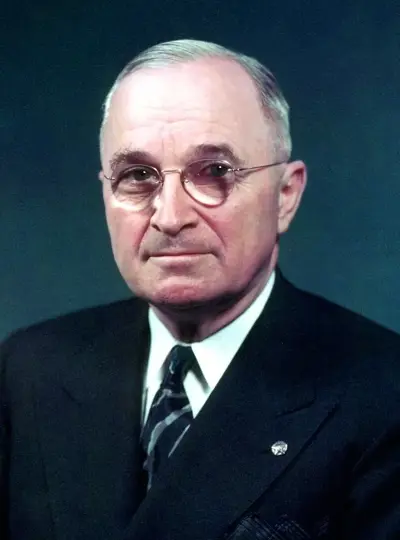
Harry S. Truman was an American politician who served as the 33rd President of the United States (1945–53). He served as a United States Senator from Missouri (1935–45) and briefly as Vice President (1945) before he succeeded to the presidency on April 12, 1945 upon the death of Franklin D. Roosevelt. He was president during the final months of World War II, and approved the plan to drop atomic bombs on Hiroshima and Nagasaki. Truman was elected in his own right in 1948. He presided over an uncertain domestic scene as America sought its path after the war and tensions with the Soviet Union increased, marking the start of the Cold War.
