John Quincy Adams Quotes
The legislation of one nation is sometimes intentionally made to bear heavily upon the interests of another. That legislation, adapted, as it is meant to be, to the special interests of its own people, will often press most unequally upon the several component interests of its neighbors.
This is often true of State and local taxes as well. Politicians have been very creative in creating taxes, rebates, credits, deductions and enforcement schemes that favor a local constituency at the expense of “outsiders” or schemes that favor specific special interest groups at the expense of the body politic and common weal.
John Quincy Adams1767-1848, 6th President of the United States (Independent, MA), State of the Union Address, Washington, DC, December 2, 1828
Sourced by: Eigen's Political and Historical Quotations


This summary of the problem of trying to politically “sell” free trade is as good as anyone has ever said it in America. And the problem and argument has not changed since. Free trade is good for most, but really harms some in specific situations. The beneficiaries often do not realize who they are or how they have benefitted, but those who are harmed generally know exactly how and what the damages are.

Although Father Dudko hated the Soviets, he was very much a Russian nationalist. So he adopted the Communist Regime position on anti-Communist foreigners who would help the anti-Soviet dissidents.

In this case the tariffs were imposed not to protect national industries but to simply raise revenue. In the early years of the United States, almost all of the Federal Revenue was raised this way.


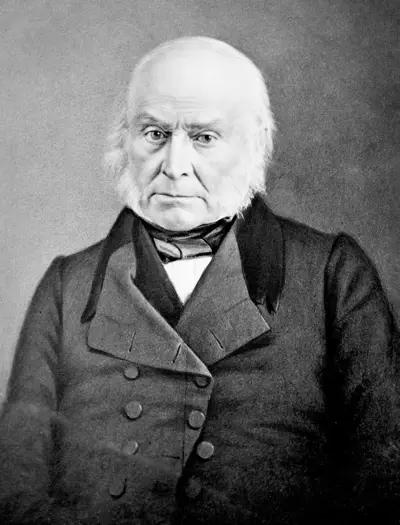
John Quincy Adams was an American statesman, diplomat, lawyer, and diarist who served as the sixth president of the United States, from 1825 to 1829. He previously served as the eighth United States Secretary of State from 1817 to 1825. During his long diplomatic and political career, Adams also served as an ambassador, and as a member of the United States Senate and House of Representatives representing Massachusetts. He was the eldest son of John Adams, who served as the second U.S. president from 1797 to 1801, and First Lady Abigail Adams. Initially a Federalist like his father, he won election to the presidency as a member of the Democratic-Republican Party, and in the mid-1830s became affiliated with the Whig Party.
