Clement of Alexandria Quotes
The law itself exhibits justice and teaches wisdom by abstinence from sensible images and by calling out to the Maker and Father of the universe.
Clement of Alexandria. The Ante-Nicene Fathers, Volume II: Fathers of the Second Century. Edited by Alexander Roberts and James Donaldson, Christian Literature Publishing Company, 1885, p. 366.


_0_thumbnail_47x47.jpg "John Gardner in 1979")


This verse has been one of the bases of Muslim theocratic states like Iran’s claim to legitimacy. The word “govern” is sometimes translated as “judge.” In the context of the 6th century, there were no separation of powers as we know them and judging, governing and legislating were melded.
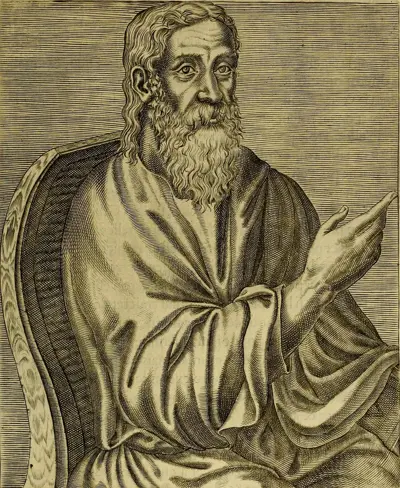
Titus Flavius Clemens, also known as Clement of Alexandria (Greek: Κλήμης ὁ Ἀλεξανδρεύς; c. 150 – c. 215 AD), was a Christian theologian and philosopher who taught at the Catechetical School of Alexandria. Among his pupils were Origen and Alexander of Jerusalem. A convert to Christianity, he was an educated man who was familiar with classical Greek philosophy and literature. As his three major works demonstrate, Clement was influenced by Hellenistic philosophy to a greater extent than any other Christian thinker of his time, and in particular, by Plato and the Stoics. His secret works, which exist only in fragments, suggest that he was familiar with pre-Christian Jewish esotericism and Gnosticism as well. In one of his works he argued that Greek philosophy had its origin among non-Greeks, claiming that both Plato and Pythagoras were taught by Egyptian scholars.
