Alexander Hamilton Quotes
The interest of the State is in intimate connection with those of the rich individuals belonging to it.
Alexander Hamilton, 1755-1804, Aide-de-camp to General Washington, Member of the Continental Congress and the Constitutional Convention, U. S. Secretary of the Treasury (Federalist, NY), Quoted in Lodge, Works of Alexander Hamilton
Sourced by: Eigen's Political and Historical Quotations


The majority had held that the income tax or any tax based on income or wealth was unconstitutional (it was less than 2% only on income over $4,000--$101,000 in 2010 dollars). It took a Constitutional Amendment to have an income tax. See {587718}.


1st Viscount Bolingbroke. See {627799} for the origin of the bias against merchants and money men. It also represents a rigidity of class structure that characterized England until very recently. The landed gentry were the first class citizens. Usually titles went with the land. In America, someone who would be successful as a merchant or a banker could achieve the highest of social status and political influence. This was not true in England where a merchant that was far more wealthy than a landed lord was not accepted by the aristocracy.


The “competition of the poor included the political and social activism competition.”


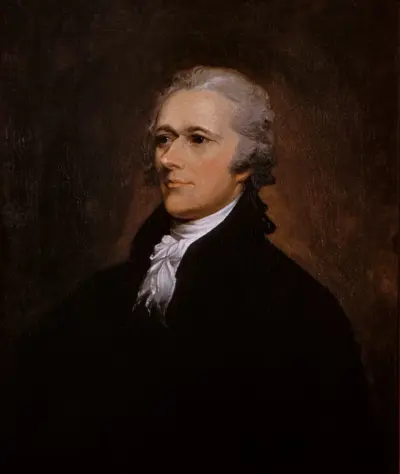
Alexander Hamilton was an American statesman, politician, legal scholar, military commander, lawyer, banker, and economist. He was one of the Founding Fathers of the United States. He was an influential interpreter and promoter of the U.S. Constitution, as well as the founder of the nation's financial system, the Federalist Party, the United States Coast Guard, and the New York Post newspaper. As the first secretary of the treasury, Hamilton was the main author of the economic policies of George Washington's administration. He took the lead in the federal government's funding of the states' debts, as well as establishing the nation's first two de facto central banks, the Bank of North America and the First Bank of the United States, a system of tariffs, and friendly trade relations with Britain. His vision included a strong central government led by a vigorous executive branch, a strong commercial economy, government-controlled banks, support for manufacturing, and a strong military.
