Charles Hodge Quotes
The Independent or Congregational theory includes two principles; first, that the governing and executive power in the Church is in the brotherhood; and secondly, that the Church organization is complete in each worshipping assembly, which is independent of every other.
Hodge, Charles. What is Presbyterianism? Presbyterian Board of Publication, 1855, p. 14.


This appears to be one of the first religious groups to withdraw and separate from a state church.

Some border state clerics were sympathetic with the South during the civil war. The pastor of the Pine Street Presbyterian Church of St. Louis, Samuel B. McPheeters, was arrested by the army in December 1862 for expressing views sympathetic to the rebellion from the pulpit. Curtis released the pastor, but prohibited him from preaching in his own church. It took Lincoln many months to find this out and Lincoln then instructed Curtis not to continue the ban.

Carroll was writing to Troy during the time of the question of Catholic emancipation in England. Here he is clearly alluding to the British form of government. Carroll never missed the opportunity to champion religious freedom as manifested in the U.S. Constitution. For an earlier example of his praise for religious freedom, see {596933}.

The struggle in the Catholic Church reached an amazing state. Just after a new pope, Martin V, had been elected the Council of Bishops at Constance came up with this notion which placed their views above those of the Pope under the theory that this particular council derived its power and authority directly from Christ while the pope was only God’s “vicar on earth.” The struggle was somewhat akin to the inevitable struggle for power between an executive branch and a legislative branch. The Council’s ascendancy didn’t last very long and was repudiated by successive popes.

to send troops to Cuba The problem in Cuba was not even a crisis for America. But the precedent became the beginning of a huge change in the balance of power between the President and Congress. Together with his huge popularity, Roosevelt could do almost anything and have public support, but the war powers—the authority to send American troops into harm’s way—started their profound shift from requiring the President to ask Congress to declare war and the President acting unilaterally which had become common by the 21st century.

John Foster Dulles was the Secretary of State and brother Allen Dulles was head of the CIA.

Withdrawal meant not allowing certain public land to be sold or allotted to homesteading, commercial development, mining, industrial, ranching, or agricultural use. It was reserved as wilderness areas and/or national parks or forests.

Although Hamilton was an advocate of a strong Federal Government, he always advocated checks and balances. Here, he called for checks on the President in the area of foreign affairs which he thought was lacking in the draft of our original constitution. His concern was not addressed and the President still has almost unilateral control over American foreign policy. The only checks are the Senate with the power to ratify treaties or not, and the Congress which need not appropriate money for purposes that the President thinks important, and can condition the money that they do appropriate upon certain limitations on the President’s preferred policies.


Reagan, Ford, Nixon, Clinton

Early in the Donald Trump Presidency, some of his first decisions, including his Anti-Muslim ban on immigration and vistitation from 7 Islamic nations, were very distrubing to amy politicians experienced in national security and defense. 100 leaders from past adminsitrations, Democratic and Republicans, signed a petition warning that the travek ban endangered our national security. Then 1000 U. S. State Department Diplomats signed a letter advising the President to recind the order for similar reasons. Malinowski was asked if this kind of opposition to a new presidents actions was unusual. This quotation was his reply. Not the use of sarcasim. He states what happened in very stark terms and then says that it is not unusual and there is notjing to worry about, when it was withotu precedent ever and very worrisome to him and others. Quotations using sarcasim are very problimatical becasue just a literal reading, would lead us to believe he was not concened with sich a common occurance.


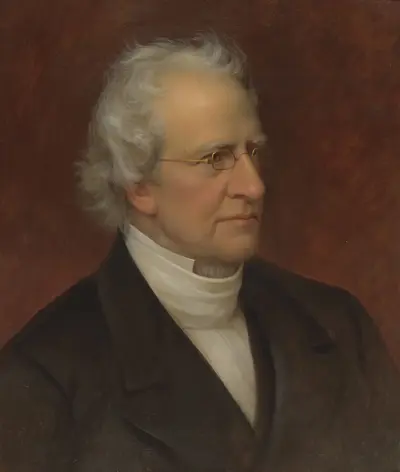
Charles Hodge was a Presbyterian theologian and principal of Princeton Theological Seminary between 1851 and 1878.
