John Quincy Adams Quotes
The greatest beggar and the most troublesome of all the office seekers during my Administration was General Harrison.
John Quincy Adams, 1767-1848, 6th President of the United States (Independent, MA), Description of then President, William Henry Harrison, 1773-1841, 1840
Sourced by: Eigen's Political and Historical Quotations


The George W. Bush administration was a throwback to an earlier era where such a spoils system was operational. Reforms had almost eliminated this type of contractor political favoritism but a culture of political corruption had developed in Congress and the Executive branch in the early 21st century that was more reminiscent of a more than a hundred years earlier. See {589738} for one of the examples that triggered the editorial.


We shall have a system where When Roosevelt became Police Commissioner, virtually every appointment, promotion, and disciplinary action was controlled politically. Nothing could be more shocking to the police and the politicians than Roosevelt’s statement. But he implemented that policy and the result developed into the finest urban police department in the country. The political influence however returned a few decades later.

For "Politics makes strange bedfellows," see Charles Dudley Warner


Nixon was a natural target for attacks and insults. At his best he was never a sympathetic or lovable figure, and at his worst his weaknesses and moral handicaps were fodder for most writers and other public figures. In this quotation collection there are many more insults targeting Richard M. Nixon than any other politician—no one has come close since.


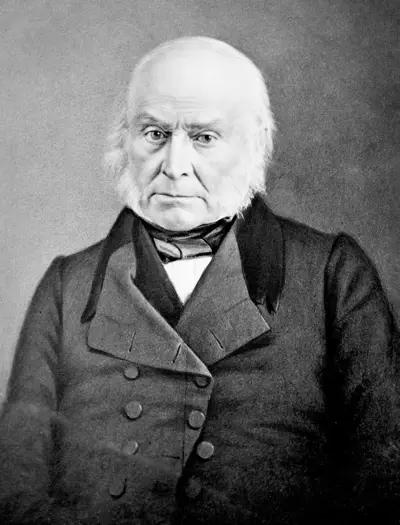
John Quincy Adams was an American statesman, diplomat, lawyer, and diarist who served as the sixth president of the United States, from 1825 to 1829. He previously served as the eighth United States Secretary of State from 1817 to 1825. During his long diplomatic and political career, Adams also served as an ambassador, and as a member of the United States Senate and House of Representatives representing Massachusetts. He was the eldest son of John Adams, who served as the second U.S. president from 1797 to 1801, and First Lady Abigail Adams. Initially a Federalist like his father, he won election to the presidency as a member of the Democratic-Republican Party, and in the mid-1830s became affiliated with the Whig Party.
