Woodrow Wilson Quotes
The great war that broke so suddenly upon the world two years ago, and which has swept up within its flame so great a part of thecivilized world, has affected us very profoundly.... With its causes and its objects we are not concerned. The obscure fountains from which its stupendous flood has burst we are not interested to search for or explore.
Wilson, Woodrow. Address to the League to Enforce Peace. 27 May 1916, Washington, D.C. The Papers of Woodrow Wilson, edited by Arthur S. Link, vol. 37, Princeton University Press, 1981, p. 113.


The Ambassador of Bavaria represented an area where the politicians saw democrats and socialists as their great enemy, as did many of the leading right wing conservatives in all of Germany. They believed that a great war would give them a chance to crush democratic socialism in Europe. Bethmann warned that just the opposite might result, and indeed it did. He was correct. Many of the crowned heads of Europe were deposed and the democratic socialists emerged as a major political factor in the victorious democracies. Bethmann-Hollweg, however, was not a strong leader and could not prevent the Conservatives, the military leaders, and Kaiser Wilhelm from initiating WWI.
English foreign and military policy had been so effective that English citizens had been completely sheltered from all the British military hostilities throughout the world. Keyserlingk and other German military planners, observing the effect that home public opinion had on war policies and practices, placed a high priority on bringing war to the British civilians and sinking merchant ships was the one way they had technologically open to them. Latter, in WWII, the same objective was achieved by the bombing of the Blitz—bombing of London and other cities with planes and rockets.


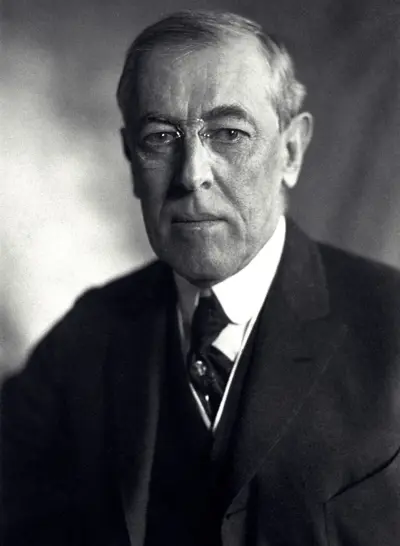
Thomas Woodrow Wilson was an American politician and academic who served as the 28th president of the United States from 1913 to 1921. A member of the Democratic Party, Wilson served as the president of Princeton University and as the 34th governor of New Jersey before winning the 1912 presidential election. As President, Wilson led the United States into World War I in 1917. He was the leading architect of the League of Nations, and his progressive stance on foreign policy came to be known as Wilsonianism. Scholars have generally ranked Wilson in the upper tier of U.S presidents, although he has been criticized for supporting racial segregation and white supremacy.
