Chiang Kai-shek Quotes
The government's duties are to support the people on the one hand and to protect them on the other ... plans for livelihood become plans for the national defense.
Chiang Kai-shek, 1887-1975, Chinese General & Statesman, Chinese Economic Theory
Sourced by: Eigen's Political and Historical Quotations


This point of view is contentious in that many people (usually those at the extreme left and extreme right) think that the intention of the founding fathers was to avoid a single executive from starting a war unilaterally. Congress was given the power to declare war—not the president. Arguably public opinion is reflected by Congress, but going to war, when public opinion has been opposed to it has always turned out badly in American History.


A common modern political issue is the relative efficiency of State verses the Federal government in the spending of tax resources, but in the area of defense, it is today assumed that this is a Federal role. However, in 1814, in the midst of a war, there were those who argued for State operation of the nation's defense. See Artemas Ward for a similar view.


Forrestal was outraged when special interests and lobbies pressured Congress and the White House regarding the policies—especially the budget and spending policies of the Department of Defense. Ironically, he was accused of endangering national security by many—especially Southerners. He had racially integrated the Navy while Secretary of the Navy and as Defense Secretary he wanted to integrate the armed forces completely. The argument against integration was that unit cohesion and military effectiveness would decrease. If nothing else, large numbers of servicemen would not want to be in close proximity to Blacks and his would impair their military effectiveness. The same arguments were later made about the integration of women and then gays.


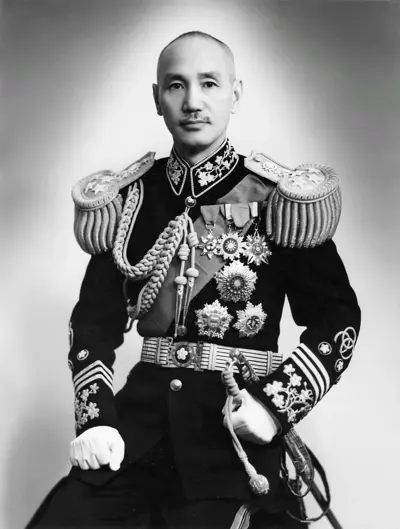
Chiang Kai-shek, also known as Chiang Chung-cheng and romanized via Mandarin as Chiang Chieh-shih and Jiang Jieshi, was a Chinese Nationalist politician, revolutionary and military leader who served as the leader of the Republic of China between 1928 and 1975, first in mainland China until 1949 and then in Taiwan until his death.
