Andrew J. Bacevich Quotes
The first obligation towards those we love is to keep them from harm. So if we love our troops, the most important thing we can do is to send them into harm’s way only if it absolutely necessary… We have abused our troops—particularly the army and the marines.
Andrew J. Bacevich, Political Scientist & Historian, Executive Director of the Foreign Policy Institute at the Paul H. Nitze School of Advanced International Studies, Referring to the Iraq War and American conflicts thereafter, PBS Moyers & Company, Interview with Phil Donahue, September 9, 2013
Sourced by: Eigen's Political and Historical Quotations


The Wars continued over a decade, costing thousands of American (and Coalition) troops their lives, many more their limbs and mental well-being, with a monetary cost of over trillions of dollars, and the achievements have been few and meager.


Ataturk was a young major at the time commanding troops of a weak and corrupt Ottoman regime. However a combined English and French (the strongest military powers in Europe) invasion of the Gallipoli Peninsula threatened to capture the Turkish capital, Constantinople. Ataturk alone rallied the Turkish defenders and fought the invaders to a standoff in long drawn out battle with huge casualties on both sides. Ataturk became a national hero. Although Ataturk thereafter was very reluctant to use military force or endanger troops, the thing he always thought worth the supreme sacrifice (including his own) was the independence and sovereignty of the nation. See {584502} for his continuing belief in this type of sacrifice.

What is particularly interesting about this quotation is that it shows the role that vengeance played in the support of the war effort. Revenge is a “baser” motive than making the world safe for democracy or preserving freedom or stopping dictators. Yet the political and military leadership did not shy away from revenge as a war aim. Contrast this with later wars. Arguably the sneak attack on Pearl Harbor created a different dimension than existed in the Korean or Vietnam wars. Yet in the War on Terror, the attack of 9-11, created a situation like Pearl Harbor did. Yet President Bush and other political and military leaders had a definite policy of never acknowledging that revenge was a factor, despite the fact that many Americans openly saw this as a major war aim.

This text, generally considered the most important of all the Hindu works is believed to be the guidance given by Lord Krishna, the most important of the God figures, to has friend and devotee Arjuna. It originally was an episode of the enormous Mahabharata, the history of the ancient world written originally in Sanskrit. The date is approximate and different scholars have dated it from 500 BC to 50 BC. The Bhagavad Gita is generally regarded as the most concise description of Hindu philosophy. For some religions, fighting and war is not only permissible but can be a religious duty. Islam has the same notion. Christianity in contrast has had more of a theological struggle with war as a duty and even had to develop the concept of a “just war” to make fighting morally permissible. But this compunction, also shared with Buddhists and Bhai for example, is by no means universal. When religious Muslims fought religious Hindus as they have for over 1000 years, it is particularly difficult even today to make peace as so many on both sides see the battle as a religious duty.


In 1963 there was only one Congressman who expressed misgivings about United States military involvement in Vietnam:

The phrase was picked up by the press, and then became the title to a patriotic song of World War II.


The American Army had just liberated Bellau Wood, but had lost almost 8,000 men.

He, Abraham Lincoln, and others thought the Mexican War an unjust and unnecessary war.

His balanced judgment and concern for American Casualties changed during the Iraq War over a decade later where he insisted on taking steady American casualties even after Saddam had been deposed and American troops were in the middle of a sectarian civil war.
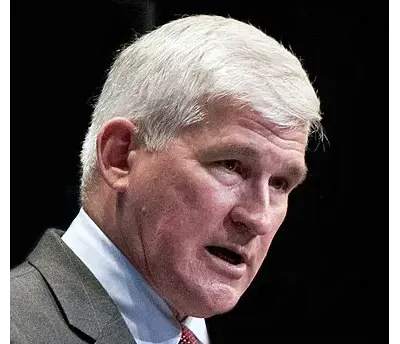
Andrew J. Bacevich Jr. is an American historian specializing in international relations, security studies, American foreign policy, and American diplomatic and military history. He is a Professor Emeritus of International Relations and History at the Boston University Frederick S. Pardee School of Global Studies. He is also a retired career officer in the Armor Branch of the United States Army, retiring with the rank of colonel. He is a former director of Boston University's Center for International Relations (from 1998 to 2005), now part of the Pardee School of Global Studies. Bacevich is the co-founder and president of the Quincy Institute for Responsible Statecraft.
