Thomas Aquinas Quotes
The fire of hell is called eternal, only because it never ends. Still, there is change in the pains of the lost... Hence in hell true eternity does not exist, but rather time.
Aquinas, Thomas. The Summa Theologica of St. Thomas Aquinas. Translated by Fathers of the English Dominican Province, Benziger Brothers, 1947, I, Q. 10, Art. 3.


Action he advocated to his followers who attacked and killed pro-slavery advocates in Kansas. The civil war of Kansas was over whether Kansas would enter the Union as a slave state of a free state. If a free state, the free states would be able to block further slavery. If Kansas were to become a slave state, the slave states would have a sufficient majority to make all future expansion hospitable to slavery. The slavery forces started sending man and families into Kansas so that they could vote; the abolitionists did the same. Both sides armed and a war began with each faction trying to kill or drive the other faction out of Kansas before the vote. See {617388} and {612516}.

This Hadith is said to represent the view of the Prophet, Muhammad. In Islam its authority is second only to the Koran itself. This quotation is given by many Muslim Imams to illustrate that suicide of any kind is contrary to Islam. Therefore these imams condemn suicide bombing as un-Islamic. Others—the terrorists—obviously disagree.


Depressed by the Union defeat at Fredericksburg in January of 1963, Lincoln observed of the presidency:


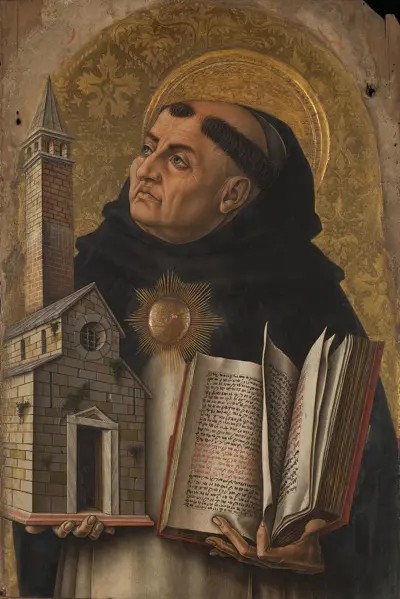
Thomas Aquinas was an Italian Dominican friar, philosopher, Catholic priest, and Doctor of the Church. An immensely influential philosopher, theologian, and jurist in the tradition of scholasticism, he is also known within the latter as the Doctor Angelicus, the Doctor Communis, and the Doctor Universalis. The name Aquinas identifies his ancestral origins in the county of Aquino in present-day Lazio, Italy. Among other things, he was a prominent proponent of natural theology and the father of a school of thought (encompassing both theology and philosophy) known as Thomism. He argued that God is the source of both the light of natural reason and the light of faith. His influence on Western thought is considerable, and much of modern philosophy developed or opposed his ideas, particularly in the areas of ethics, natural law, metaphysics, and political theory.
