George Washington Quotes
The establishment of the militia, of a mint, of standards of weights and measures, of the post office and post roads are subjects which I presume you will resume of course, and which are abundantly urged by their own importance.
Note the mild tone of asking the Congress to deal with crucial issues. Although almost revered as a king, Washington was very respectful of the independence of Congress on legislative affairs. Congress however did not act on these measures in that term.
George Washington, 1732-1799, 1st President of the United States (VA), Second Annual Message to Congress, December 8, 1790
Sourced by: Eigen's Political and Historical Quotations


At the time, there was no United States currency. Private banks in some of the states issued their own money. A dollar from Georgia might only be worth 75 cents in New York.


Specie is a word for paper money. Such political artifices were well known in More’s time, and yet still exist in many countries.


At the time, roads were built by the states. This was one of the first instances urging that the Federal Government take some responsibility for roads. This would culminate when President Eisenhower proposed and created the National Highway System and as Madison predicted, it would have a massive economic benefit for the nation.


Although Madison vetoed the Federal bill to improve the national infrastructure, he was very much for the improvements and he said so in this veto message. He, however, did not see the Constitutional authority for the Federal government to appropriate moneys to be spent in the States for infrastructure improvement. He was for a Constitutional Amendment to do so or to make the improvements using State money as New York did building the Erie Canal. Alexander Hamilton, and many of the Congressmen who voted for the bill disagreed (many of whom were also in the Constitutional Convention) and did not see the Constitutional limitation that Madison did. See Hamilton’s Quote 644278. He was particularly concerned that small and less affluent states could not possibly have the skill to design these or the finances to build them. Later President’s and Congresses sided with Hamilton. It would be hard to envision America today of Madison’s view had prevailed.


During the Civil War, the U. S. Government printed paper money (specie) for the first time. 20 years afterward, the paper money was still controversial.

This is a very interesting quotation in that it is one of the first suggestions that money debasement can be caused by a lack of trust and confidence in the government rather than the percentage of precious metals in the coins.
This quotation is interesting for 3 reasons. First, it demonstrates that in 1816 the nation still did not have a standard system of weights and measures. Second, note the very polite and politic manner that Madison told the Congress to get busy and do their job. Third, here is Madison talking about a decimal based system. The English system was unique in Europe and all the other countries led by France used a metric system based on 10. Americans, despite the hostility then towed England, there was little support for a metric system. Madison and other leaders, who knew the metric system to be far superior felt that it was more important to have any standard system of weights and measures and so no one held out for a metric system which never was accepted by Americans who were not scientists or worldwide manufacturers.
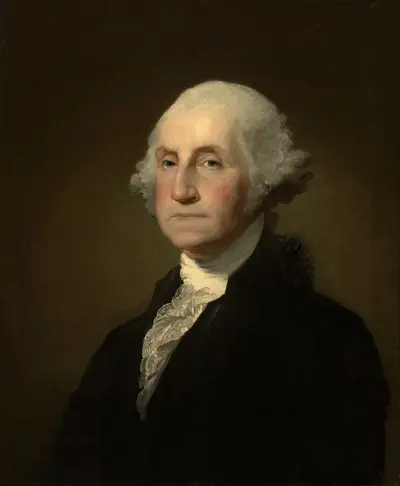
George Washington was the first President of the United States (1789-97), the Commander-in-Chief of the Continental Army during the American Revolutionary War, and one of the Founding Fathers of the United States. He presided over the convention that drafted the current United States Constitution and during his lifetime was called the "father of his country".
