Thomas More Quotes
One proposes raising the value of specie when the King's debts are large, and lowering it when his revenues were to come in, that so he might both pay much with a little, and in a little receive a great deal: another proposes a pretence of a war, that money might be raised in order to carry it on, and that a peace be concluded as soon as that was done; and this with such appearances of religion as might work on the people, and make them impute it to the piety of their prince, and to his tenderness for the lives of his subjects.
Specie is a word for paper money. Such political artifices were well known in More’s time, and yet still exist in many countries.
Thomas More, 1478-1535, Speaker of the House of Commons, Lord Chancellor of England, Catholic Saint, Examples of Cabinet Ministers who advise a king for short term gain but harm the kingdom, Utopia, 1516
Sourced by: Eigen's Political and Historical Quotations


The very act of printing money created a debt—at the time and until the Nixon Administration which went off the gold standard—the government owed the gold or silver and the spicie—the printed money—was a promissory note.


Note the candor with which the Congress provided the truth to Americans about the financial situation of the nation. Despite the national crises and emergency of the war, the Congress told the truth and did not treat the citizens as children from whom bad news must be withheld. At the time, each state and many individual banks had their own paper currency, these could be easily counterfeited and were done so by the British to collapse the American economy. Because of this early traumatic experience with paper money, the United States did not use it for another 70 years.

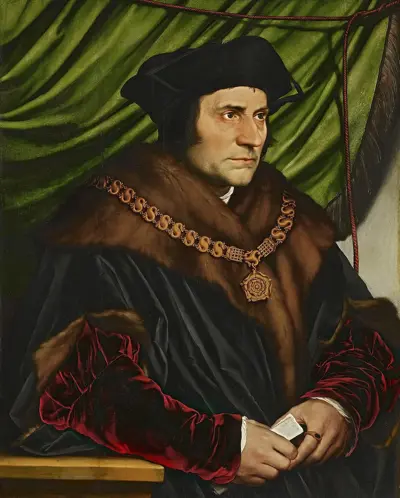
Sir Thomas More, venerated in the Catholic Church as Saint Thomas More, was an English lawyer, judge, social philosopher, author, statesman, and noted Renaissance humanist. He also served Henry VIII as Lord High Chancellor of England from October 1529 to May 1532. He wrote Utopia, published in 1516, which describes the political system of an imaginary island state.
