Mikhail Gorbachev Quotes
The emerging 'environmentalization' of our civilization and the need for vigorous action in the interest of the entire global community will inevitably have multiple political consequences. Perhaps the most important of them will be a gradual change in the status of the United Nations. Inevitably, it must assume some aspects of a world government.
Gorbachev, Mikhail. "The River of Time and the Imperative of Action." 6 May 1992, Westminster College, Fulton, MO.


Those environmentalists who take this view do not give credence to other alternatives. For example, the same argument of environmental decision-making could logically justify one superpower nation taking over the government of all others on the planet for environmental matters. Another possibility is that the existing mechanisms and the UN are sufficient if the major powers reach agreement. Another is that science and technology will provide solutions.

The Paris Agreement was an agreement within the United Nations Framework Convention on Climate Change (UNFCCC) dealing with greenhouse gases emissions mitigation, adaptation and finance starting in the year 2020. The language of the agreement was negotiated by representatives of 195 countries at the 21st Conference of the Parties of the UNFCCC in Paris and adopted by consensus on December 12, 2015. Never before in the history of the world had that many nations agreed on anything. Yet the United States Donald Trump administration, and a significant proportion of right wing and Tea Party Repoblicans actually believed that the threat of climate change was a hoax and at best the erroneous conclusion of "left wing" scientists. Within the wcientific community in the United State, there were very few major scientific issues for which there was almost unanamous consensus. Climat change and the role of humans in accelerating it was one of those.

When he made this statement, the United States was the only nation that had the atomic bomb, but he and other leading nuclear scientists realized that it would not be long before the Russians would also have nuclear weapons, and other countries would so follow suit. He and some others saw a world government as the best way to cope with the nuclear proliferation problems. However, there was too much diversity of values and political ideology in the world to be accommodated in a single government, and the United Nations was the only thing that was practical and that was far from a government and had virtually no sovereignty. However, during the Cold War, Russia and the United States agreed on a Nuclear Proliferation Treaty and most nations of the world, agreed, so that for the issue of nuclear proliferation, the world had a type or world government—an international treaty. However, India and Pakistan did not adhere to it and developed nuclear weapons and North Korea was never a signatory. Other countries like Iran began to evade the treaty and since there was no real world government it was difficult to enforce the treaty throughout the world.


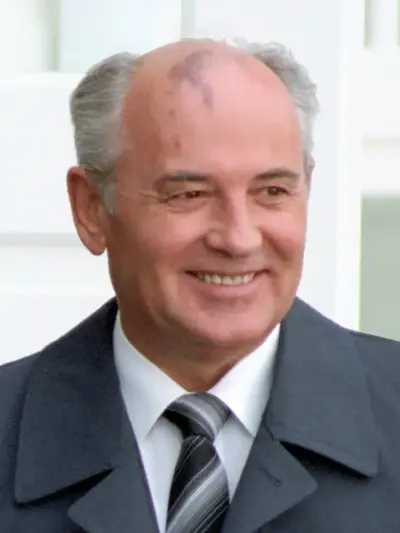
Mikhail Sergeyevich Gorbachev is a Russian and former Soviet politician. The eighth and last leader of the Soviet Union, he was the General Secretary of the Communist Party of the Soviet Union from 1985 until 1991. He was also the country's head of state from 1988 until 1991, serving as the chairman of the Presidium of the Supreme Soviet from 1988 to 1989, chairman of the Supreme Soviet from 1989 to 1990, and president of the Soviet Union from 1990 to 1991. Ideologically, Gorbachev initially adhered to Marxism–Leninism, although he had moved towards social democracy by the early 1990s.
