Friedrich Nietzsche Quotes
The domestication (the culture) of man does not go deep--where it does go deep it at once becomes degeneration (type: the Christian). The 'savage' (or, in moral terms, the evil man) is a return to nature--and in a certain sense his recovery, his cure from 'culture'.
Nietzsche, Friedrich. The Will to Power. Translated by Walter Kaufmann and R. J. Hollingdale, Vintage Books, 1968, Aphorism 684, p. 364.


The “brother of the wolf” refers to the evolution of the dog from the wolf which it now appears took place in just a relatively few generations.


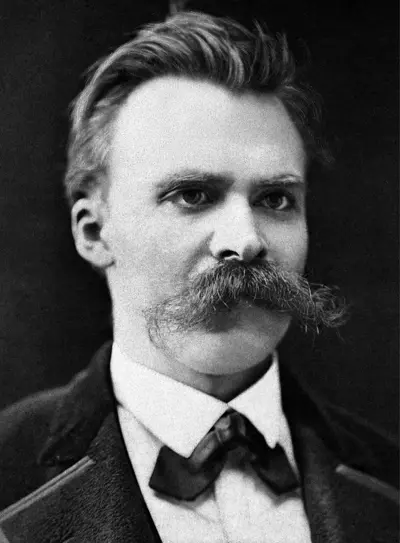
Friedrich Wilhelm Nietzsche was a German philosopher, cultural critic, composer, poet, writer, and philologist whose work has exerted a profound influence on modern intellectual history. He began his career as a classical philologist before turning to philosophy. He became the youngest person ever to hold the Chair of Classical Philology at the University of Basel in 1869 at the age of 24. Nietzsche resigned in 1879 due to health problems that plagued him most of his life; he completed much of his core writing in the following decade. In 1889, at age 44, he suffered a collapse and afterward a complete loss of his mental faculties. He lived his remaining years in the care of his mother until her death in 1897 and then with his sister Elisabeth Förster-Nietzsche. Nietzsche died in 1900.
