Warren E. Burger Quotes
The Constitution does not require complete separation of church and state; it affirmatively mandates accommodation, not merely tolerance, of all religions, and forbids hostility toward any.
Burger, Warren E. Majority opinion. Lynch v. Donnelly. 465 U.S. 668. Supreme Court of the United States, 1984, p. 673.


This quotation is one of the first to make the critical observation that the only time that tolerance of a religion is necessary is when there is an established church and others that deviate from it. If there is no established church, as the Founding Fathers envisioned, there is no preeminent church to do the tolerating. All are equal. In practice, Protestant churches were proportionately dominant in early America and up through the 20th century. So most of the issue of tolerance problems in America were cultural. And there is still a minority of Christians who believe that America should be a Christian country and other religions should be “tolerated.” However, Clinton and most of the founders did not want to see even general Christianity established as the national religion even they it was the majority religion.

This is a critical quotation on the government establishment of religion issue. There are a few people who have argued over the years that the Founding Fathers and their culture was religious and where they were careful to avoid favoring one religion over another, they did NOT intend to put atheism on the same equal plane as religion as far as government action is concerned. However, some of the Founding Fathers were atheists, and some others like John Adams were deists—they believed in a God but not in the Trinity or in Judaism or any organized religion. So this quotation makes it clear that the First Amendment does NOT favor religion over non religion or secularism. Atheism must be on an equal footing but not on a higher plane.


Later, as President in 1811, Madison vetoed a bill granting Federal land to build a Baptist church in the Mississippi territory.


Falwell was a religious fundamentalist who advocated religion vigerously participating in politics.


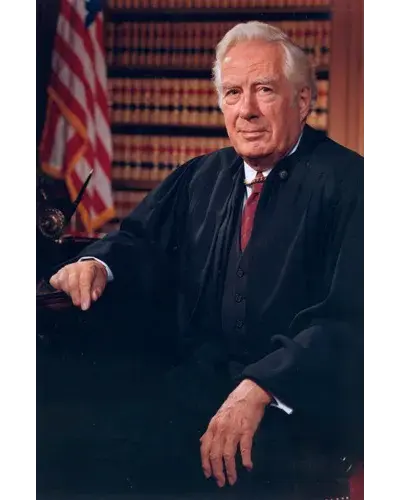
Warren Earl Burger was the 15th Chief Justice of the United States Supreme Court, serving from 1969 to 1986. Born in Saint Paul, Minnesota, Burger graduated from the St. Paul College of Law in 1931. He helped secure the Minnesota delegation's support for Dwight D. Eisenhower at the 1952 Republican National Convention. After Eisenhower won the 1952 presidential election, he appointed Burger to the position of Assistant Attorney General in charge of the Civil Division. In 1956, Eisenhower appointed Burger to the United States Court of Appeals for the District of Columbia Circuit. Burger served on this court until 1969 and became known as a critic of the Warren Court.
