Thurgood Marshall Quotes
The complete destruction of all enforced segregation is now in sight.
This article was written after the successive Supreme Court decisions on June 5, 1950 that found segregation in certain cases unconstitutional.
Thurgood Marshall, 1909-1993, U. S. Supreme Court Justice, Baltimore Afro-American, June 17, 1950
Sourced by: Eigen's Political and Historical Quotations


Quoted in the Court’s notes of the meeting. At the time the justices were split 5-4 with the majority reluctant to overturn segregation. They tended to be much older and from the South. Jackson was prescient. Shortly thereafter Chief Justice Vincent passed away and Earl Warren replaced him. The 5-4 majority was for desegregation now. However, Warren negotiated with the minority and finally produced a unanimous opinion against legal segregation. As Jackson had predicted, “it had come.”

This was the first major civil rights speech. He had previously in his political career tread carefully in the civil rights arena. The Southerners had disproportionate control over the Congressional committee chairmanships and they could hold up his entire legislative agenda. JFK’s father was a right wing fascist who supported Hitler earlier and always advised against pushing civil rights.

In the middle of WWII where Black soldiers were fighting and dying on the war front, there were fears of racists that the Blacks would return and demand full equality and an end to segregation. There were threats in the South of armed attacks against any returning serviceman who would push for desegregation.


The statement was made even more dramatic as the outgoing Governor, Lester Mattox, standing behind Carter at the ceremony, was an arch segregationist.


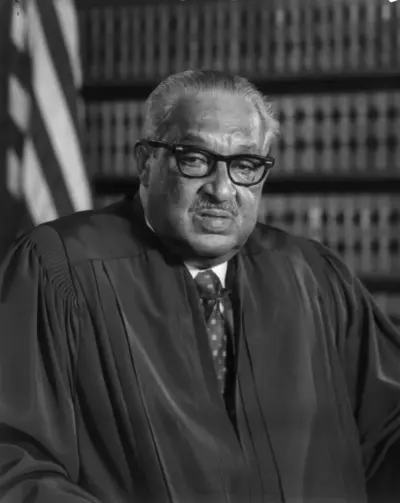
Thurgood Marshall was an American lawyer and civil rights activist who served as Associate Justice of the Supreme Court of the United States from October 1967 until October 1991. Marshall was the Court's first African-American justice. Prior to his judicial service, he successfully argued several cases before the Supreme Court, including Brown v. Board of Education.
