Robert X. Cringely Quotes
The companies that can afford to do basic research (and can't afford not to) are ones that dominate their markets. … It's cheap insurance, since failing to do basic research guarantees that the next major advance will be owned by someone else.
He is referring to high technology companies or companies that utilize technology in their business processes in unique ways. McGraw Hill, the publishing company, is a dominant firm, but does very little basic research. Nor does the New York Times Company, the world’s dominant newspaper.
Robert X. Cringely, Writer & Technologist, Accidental Empires, 1992
Sourced by: Eigen's Political and Historical Quotations

This is why the American Government has played such a major role in most of the great technologies in American History. Interchangable Parts (A federal contract with Eli Whitney), Canal Construction (New York State built the Erie Canal), the Railroad (federal government gave hugh tracts of land to build the rail lines to the West), the Telegraph (No one would use it until the government financed the experiment to prove it by creating a line between Baltimore and Washington), AC Electricity, there the city of Rochester NY hired Tessler and Westinghouse to Demonstrate Generating Electricity at Niagra Falls and transmitting it over 20 miles which Edison’s Direct Current could not do), immunization (the Army Medical Corps gave the first grants to universities to develop the science of vaccines and immunization, the computer (in WWII the U. S. financed the development of computers sent to England to implement Turing’s breaking of the German “unbreakable” code), atiomic energy (the Manhattan Project—the largest scientific endeavor the world has known), the Internet (Developed with long term research funds for DARPA the future technology research arm of the Defense Department. American investors and businesspeople took each of these and developed them but the initial steps, when no capitalist dared risk on such basic and futureistic efforts were taken by American Government which probably could never have developed these technologies but the private sector could not do it with government in the role Moritz herein describes.


The president was explaining the importance of the Trans-Pacific Partnership (TPP) which his administration had successfully negotiated with most Pacific Nations but had run into significant opposition in the United States, where trade pacts in general were being blamed by many Americans—–including politicians—–for the low wages and not enough jobs for many middle and lower class workers who did not experience quality education in science, technology, engineering and mathematics or a few other areas that www in great demand.


What makes this quote significant is the data—the end of the 19th century and here was an author, in a prestigious journal, warning about the potential economic competition from China which at the time was seen by most as a backward, primitive civilization which could never compete with the West. Also, Hearn was the first writer who communicated information about Asia to Americans on a large scale.

GDP is Gross Domestic Product—the size of the economy of the country. Israel devotes a larger proportion of its economy to research than any other nation. This is one of the reasons that that have such a highly developed workforce and economy. Israeli science and technology are used in every country of the world including the Arab Nations whose politicians and populace do not even realize that they use Israeli technology as the Arab nations are among the lowest investors in R&D and produces few scientists.


Here, an officer of a large corporation (Pittsburgh Plate Glass) makes the classic argument of large corporations about the anti-trust laws which prevent them from using their economic power to crush competition. The claim that the large corporations are at a disadvantage and handicapped in competing with small companies is easily refuted by the bankruptcy rate of small businesses which is large, and that of large corporations which is very small, and that of major monopolies which is virtually zero.
It is not only the companies of rich nations that equip their people, but also the non-profit sector including the universities.
Patents, copyrights, and franchises are but 3 common (and legal) ways of obtaining a onopoly position.See Adam Smith {627790} for a similar thought.

He made this quotation in a discussion about nuclear weapons, but the principle is valid for many areas from the Internet to pharmaceuticals. In the nuclear weapons case there have been a number of accidents – including fatal ones – over the years and on several occasions a nuclear weapon came close to detonating near populated areas. In one case, radiation damage from a crash of a nuclear weapons equipped bomber have made an area in Spain unusable for years into the future.

Boeing had the foresight to invest in the concept of Air Mail by bidding low at the beginning, becoming the best in the nation, and then raising prices when no one else can compete—a technique called “buying in”. However, he was so successful that he soon had a monopoly on all the airmail in the country. Each new airmail contract would require more and more capability and Boeing used the existing contracts to finance the R&D and training of manpower to present a better and better service. Soon, no other company could compete at any price. Boeing indeed had a monopoly but each step of the building of it he did at the request of the government or was the low bidder and saved the taxpayer money. The airmail contracts were canceled and air service was nationalized. William Boeing was so disgusted by the way he was treated in the Congressional Hearings, that he sold his interest in the Boeing Company and would have nothing to do with making planes or providing services to the government thereafter.

This is an important quotation because Ellison, one of the best businessmen in the world is also much more candid than most others. Here he admits that he strives to achieve monopoly status for his company. Almost all large businesses try to become monopolies so that they do not have to compete on price, quality, and service. Few will admit publicly that much of their effort goes towards an objective that is detrimental to the nation and society and in is in large part illegal.

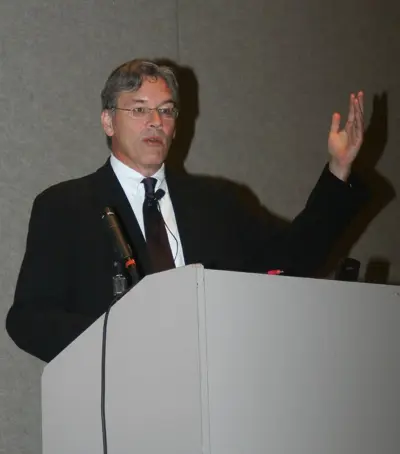
Robert X. Cringely is the pen name of both technology journalist Mark Stephens and a string of writers for a column in InfoWorld, the one-time weekly computer trade newspaper published by IDG.
