Dean Inge Quotes
The command "Be fruitful and multiply" was promulgated, according to our authorities, when the population of the world consisted of two people.
William Ralph Inge, 1860-1954, British Anglican Prelate & Dean of St. Paul's, More Lay Thoughts of a Dean, 1931
Sourced by: Eigen's Political and Historical Quotations


In Burundi, family land is divided among the male children of a family. The average Burundian woman has 6.3 children, nearly triple the international fertility rate. With this fertility rate, the plots of land for each person inevitably get smaller and smaller over time. At 10,745 square miles, Burundi is slightly smaller than the U.S. state of Maryland, but it holds nearly twice as many people: about 10 million. The small plots of land are inefficient to farm and provide subsistence. So the nation was in a crises as there was little industrialization and land was essential for existence for most Burundians. See {35808} and {35809}.


The logic is that communities and areas—even countries have finite resources. Since we have a welfare society in which we will not allow people to starve, society must provide for children whose parents cannot. Therefore, individuals ought not to be allowed to breed beyond their ability to care for the children for if many would do so, the capacity of the community could be overwhelmed. A middle ground is that while the final decision should be left to the individual family, the society ought to educate and persuade members to limit their breeding.


This is a counter-intuitive fact which surprises almost everyone. Note that he does not claim that the entire world population could all live in New York, but the enormous amount of indoor space is clearly illustrated by the fact that all could fit in to the city.

One of the most contentious activities in all political history is a government trying to regulate the number of children which its citizens can have. When a government tries to do this, they run into opposition by some religious people who oppose birth control in general or some birth control methods (eg abortion). In addition it is opposed by many people who do not want the government involved at all in a decision that is so personal. Yet many governments, under the press of perceived overpopulation, or in an effort to limit mental retardation, have attempted such regulation and that includes the United States where 40 states have at one time or another practiced forced sterilization of people who the state believed were unfit to bear children. China and India—the largest nations of the world—have both maintained government policies and practices to control population with China making it illegal to have more than 1 child. These programs have reduced the population counts, but at a terrible ethical cost and resentment of the affected people.


This is a very valuable historical quotation as it gives is a flavor of 19th century attitudes about birth control. Malthus was one of the first to warn about the danger of overpopulation. But even he repudiated birth control as a potential solution. Toynbee was giving a scholarly academic lecture and academics whenever they discussed birth control were expected by many to speak or write only in Latin—the “dead language.” Toynbee, a very young brilliant man—he died at only 31—was considered very daring as he actually discussed it in English. The assumption of all at the time, in that Protestant culture, was that birth control was immoral. The logic of it was that sex was pleasurable, but as children would likely result, the parents would have and accept responsibility. Pleasure without the concomitant responsibility might lead to sex for pure enjoyment and much time spent with pleasure. The production of children and the responsibility thereof was therefore a break and limitation on the amount of time that people would spend with sex. There was the Protestant work ethic and too much sex would detract from work, prayer, parenting, scholarship, and activities of social responsibility. In America there was a similar cultural view of birth control and even as late as 1963 the criminal law was used to restrict birth control. A Connecticut pharmacist was jailed for filling a doctors prescription for condoms for a married couple where the wife’s life was threatened if she bore another child. The Supreme Court overturned the conviction, but birth control and abortion were conflated. Even today, many of the so called “pro life” organizations not only oppose legal abortion, but they want the government to restrict birth control, though tactically they emphasize the abortion publicly. The English and American family planning advocates like Margaret Sanger were up against these attitudes on which there is stll some controversy into the 21st century.


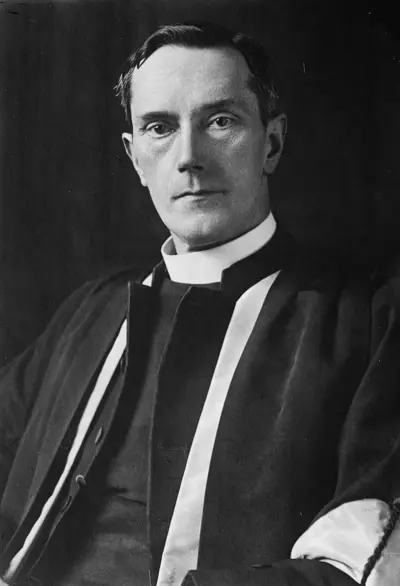
William Ralph Inge KCVO FBA (/ˈɪŋ/; was an English author, Anglican priest, professor of divinity at Cambridge, and Dean of St Paul's Cathedral, which provided the appellation by which he was widely known, Dean Inge. He was nominated for the Nobel Prize in Literature three times.
