Michael Hayden Quotes
The CIA held about a hundred detainees from 2002 to 2008; about a third of them underwent interrogations that have been variously described as enhanced, tough or torture. The toughest technique was water boarding, used on three detainees, the last in early 2003.
Hayden, Michael V. Playing to the Edge: American Intelligence in the Age of Terror. Penguin Press, 2016.


During that period some terrorists were handed over to Saudi Arabian and Egyptian authorities for interrogation. These countries had no qualms about torture. Goss never answered the question about that practice.

The President and Vice President wanted places to interrogate suspected terrorists where they did not have to obey American law, where the press could be kept away from the prisoners, and there would be no way that a prisoner could get the assistance of attorneys and American Judges could not have any jurisdiction. A number of the prisoners had been picked up by mistake, or were accused by people who had scores to settle, and if the CIA had made a mistake, the public could not find out. Further, they wanted to torture certain prisoners and wanted places where they could use their “enhanced interrogation”—see {637536}--without the public finding out.

Several American soldiers have been court marshalled and found guilty of illegal torture for Warterboarding prisoners to induce them to provide information. Most experts agree that intelligence received this way is highly unreliable in that victims will say anything they think the torturer wants to hear to get the torture to stop.


The press were asking about the claim that the United States were sending detainees (“rendition” it is called) in the War on Terrorism to countries where they are tortured in ways that United States law prohibited. This quotation is an excellent illustration of the nuanced language that is sometimes used by politicians with the press. For example this statement was made in the Press Conference about our Human Rights Annual report. In it specific countries were named and accused of torturing prisoners or suspects. The press had learned that detainees had been renditioned to those same countries. Lowenkron went on to explain that U. S. officials had explained to officials of the countries to which detainees had been renditioned that the detainees should not be tortured; therefore they did not BELIEVE that they would be. So the statement was “correct” whether or not they detainees had been tortured. In another nuance, some people wondered what “we” meant—the United States or the State Department. Perhaps the State Department followed this policy and practice but the CIA may not have.

Major Fleener had been assigned to defend accused terrorists who were being held at the military prison in Guantanamo, Cuba. For several years they were held without a hearing or trial. Then the U. S. Supreme Court ruled that they had to be given a hearing or trial. A Military tribunal was selected. The methods and procedures of these hearings came under much public world-wide criticism as they did not meet the normal legal standards of most countries. Surprisingly, one of the military officers made public statements criticizing the army and the trials.


In the War on Terror, some CIA officers had gotten a George W, Bush Administration green light to torture some captured terrorists using a torture technique known as “water boarding”—a practice for which American military personnel were court marshaled and convicted in the Philippine War. The torture sessions had been videotaped, a normal procedure with CIA interrogations. The fact of the torture had leaked and a national scandal ensued with Americans on both sides of the question. President Bush and his Vice President publicly stated that the United States does not torture. Rodriguez then ordered the tapes destroyed. Later he gave his reasons after the Obama Administration decided not to investigate the matter or determine which, if any, CIA officials might have broken the law, by wither doing the torturing or destroying evidence—“obstructing justice.”
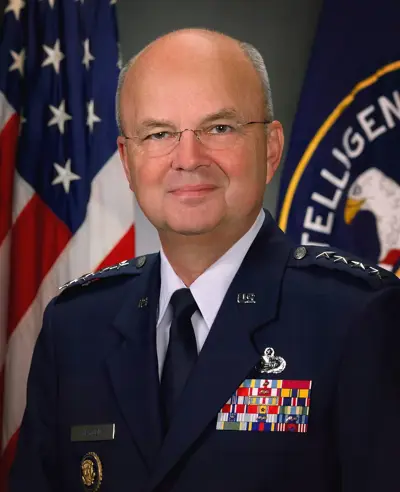
Michael Vincent Hayden is a retired United States Air Force four-star general and former Director of the National Security Agency, Principal Deputy Director of National Intelligence, and Director of the Central Intelligence Agency. Hayden currently co-chairs the Bipartisan Policy Center's Electric Grid Cyber Security Initiative. In 2017, Hayden became a national security analyst for CNN.
